Airline Reviews12 min readairline-reviewetihadabu-dhabi
Etihad Business Class Review 2026: Abu Dhabi's Premium Renaissance
Etihad's business class in 2026 is genuinely one of the better products flying out of the Gulf, built around the Business Studio seat on its 787-9 fleet and a chauffeur service that still shows up…
BC
BestBusinessClass Team
June 13, 2026
Share
Quick summary
Etihad's business class in 2026 is genuinely one of the better products flying out of the Gulf, built around the Business Studio seat on its 787-9 fleet and a chauffeur service that still shows up when other airlines have quietly cut it. Published fares from JFK to Abu Dhabi run $4,500 to $8,500 round-trip, but BestBusinessClass.com has been booking the same routes for $2,000 to $3,800 through consolidator fares. This Etihad business class review 2026 covers the seat, the food, the Abu Dhabi lounge, and where Etihad still loses to Emirates.
I'll say this upfront: I didn't expect to like Etihad as much as I did on my last two trips through Abu Dhabi. The airline spent the better part of a decade in crisis mode — massive losses, a fleet that didn't match the ambition, a strategy that seemed to change every eighteen months. And then, somewhat quietly, it fixed itself. The 2026 version of Etihad business class isn't flashy in the way Emirates is flashy. It's just consistently good, which honestly might be more impressive.
This is my full rundown after flying the airline twice in the past year, once JFK–AUH and once AUH–LHR, both in Business Studio on the 787-9.
What is Etihad's business class actually like in 2026?
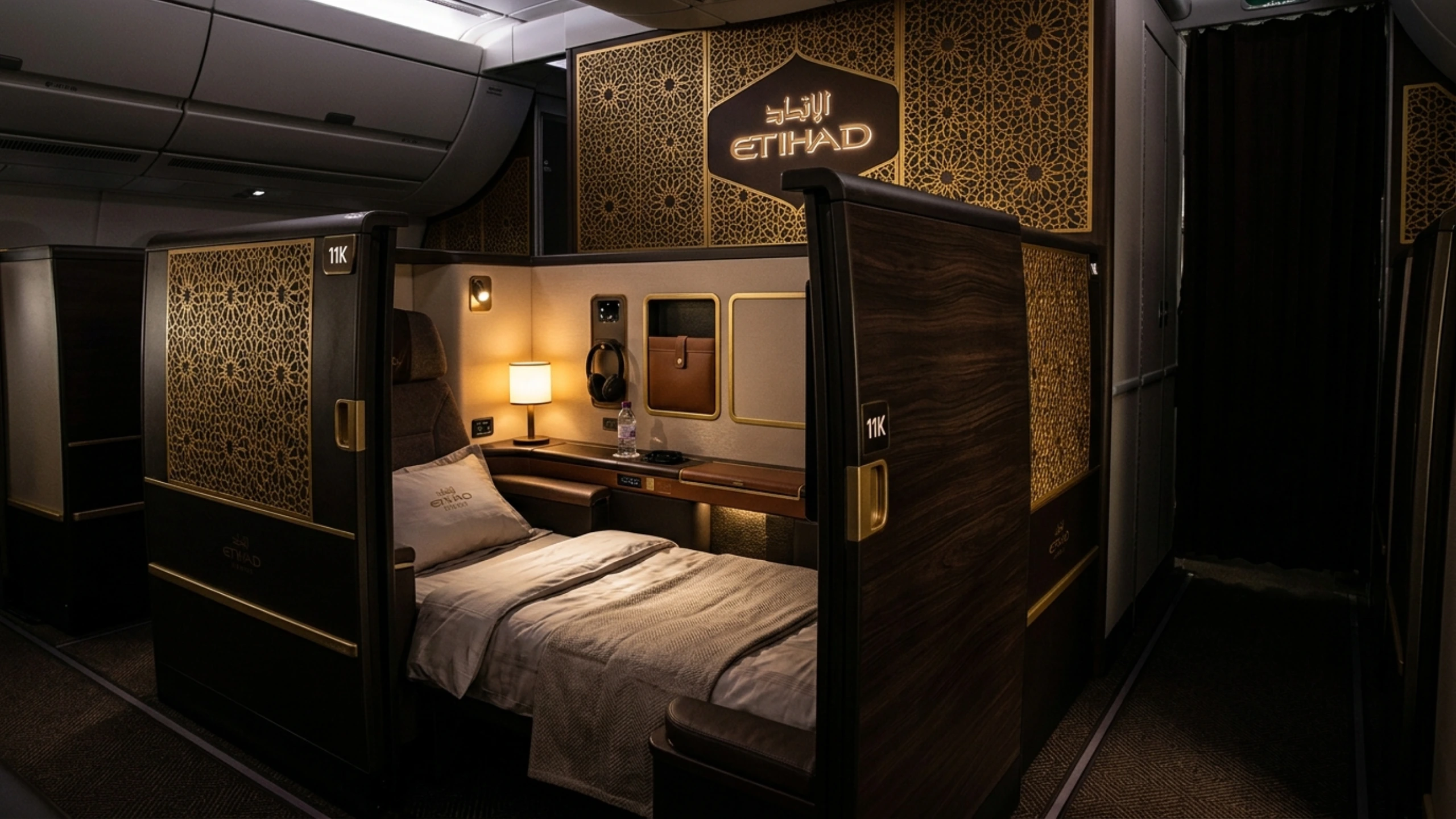
Etihad's current business class product centers on the Business Studio, a reverse herringbone-style seat that debuted on the 787-9 Dreamliner and has since rolled out across most of the long-haul widebody fleet. It's not a suite with a door — Etihad keeps those for The Residence and first class on select A380 routes — but it's a fully flat bed with direct aisle access from every seat, which puts it in the same category as Qatar's Qsuite-adjacent products and well ahead of what Emirates flies on most of its 777s.
The seat itself is 21 inches wide, extends to a fully flat 78 inches, and comes with a decent amount of storage — a proper hanging space for a jacket, a spot for your phone with wireless charging, and a footwell that's actually big enough for someone over six feet tall to stretch out. I'm 6'2" and didn't have to sleep at an angle, which is more than I can say for a few Middle Eastern carriers I won't name here.
8.2/10
BestBusinessClass.com rating for Etihad business class, 2026
The cabin is quiet, the lighting is soft rather than clinical, and the whole thing feels like it was designed by people who actually fly business class rather than people optimizing for a spec sheet. That's not something I'd have said about Etihad in 2018.
Is Etihad getting new planes in 2026?
Yes, and this is the part of the Etihad story that doesn't get enough attention. The airline has A350-1000s on order, with deliveries continuing through 2026 and into 2027, alongside a growing 787-9 and 787-10 fleet. The A350s will carry an updated Business Studio with a slightly refreshed cabin finish and, from what Etihad has previewed, a redesigned entertainment interface.
What this means practically: if you're booking now, you'll most likely fly the 787-9, which is already excellent. But the network is in the middle of a real hardware upgrade, not just a paint job, and that matters when you're comparing Etihad to Emirates, whose 777 business class cabin in many configurations is genuinely showing its age.
Pro Tip
When booking through BestBusinessClass.com, ask specifically for 787-9 or A350 routings. Etihad still flies some older 777s on secondary routes, and the business class hard product on those is noticeably behind the Business Studio.
The chauffeur service — does it still exist, and is it any good?
It does, and it's one of the few genuine perks in this industry that hasn't been quietly gutted. Etihad's complimentary chauffeur service is available for business class ticket holders in over 60 cities, including New York, London, Abu Dhabi, and most major departure and arrival points. You book it through the Etihad app or website at least a few hours before departure, and a driver meets you — Mercedes S-Class or similar, depending on the city — and takes you straight to the terminal.
I used it from a hotel in Manhattan to JFK and the car showed up eight minutes early, driver already out and holding a sign with my name misspelled by exactly one letter, which felt appropriately real-world rather than staged. No upsell, no hovering for a tip, no confusion about the route. On the arrival side in Abu Dhabi, the same thing happened in reverse — a car waiting past immigration, no line, no fuss.
Emirates offers something similar but it's more selectively applied and, in my experience over the years, has been trimmed back on shorter routes. Etihad's version still feels like it was designed to be used, not just advertised.
Dining and service — where Etihad quietly wins
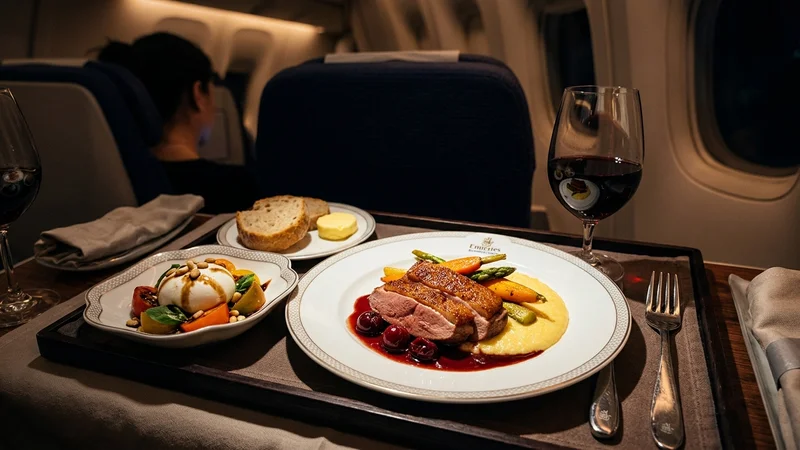
This is where I think Etihad has actually pulled ahead of some of its bigger regional rivals. The onboard dining program partners with a rotating list of chefs — on my JFK flight, the menu credited a dish designed with a Michelin-recognized chef based in Abu Dhabi, and it wasn't just a name attached for marketing. The lamb ouzi was properly seasoned, the rice wasn't mush, and portions were sized for an actual meal rather than a tasting plate.
Breakfast before landing in Abu Dhabi included a shakshuka that I'd happily order at a restaurant, not just tolerate at 35,000 feet. Etihad also does an "dine on demand" service that lets you order at any point during the flight rather than at fixed meal service times, which sounds minor until you're on an eight-hour flight and want food two hours before landing instead of right after takeoff.
Service-wise, crews on both my flights were attentive without being intrusive. Names were used, requests were remembered without being repeated, and nobody disappeared for ninety minutes after the meal service like happens on some carriers I've flown that shall remain nameless (looking vaguely eastward).
What to order
If it's on the menu, get the slow-cooked lamb ouzi. It's become something of a signature dish on Etihad's long-haul routes and it's consistently better than the beef options.
The Abu Dhabi lounge — is it worth the layover?
Etihad's home lounge at Abu Dhabi International's Terminal A is legitimately one of the better hub lounges I've used, and that's coming from someone who's sat in the Qatar Al Mourjan lounge in Doha more times than I can count.
The space is large without feeling like an airport food court, split into a few distinct zones — a quiet seating area, a proper à la carte dining section with table service, a spa with treatment rooms, and a business center if you actually need to get work done. The shower suites are large, the water pressure is strong, and the towels are the kind you'd get at a decent hotel, not the thin gym-towel situation some lounges still hand out.
Food in the lounge dining room rotates seasonally and skews Middle Eastern and Mediterranean, with a solid Arabic mezze spread and a made-to-order grill station. I had a lamb kofta plate there that was better than some restaurant meals I've paid for in actual restaurants.
Where it falls slightly short of Emirates' Concourse A lounge in Dubai: seating can get tight during peak departure banks in the early morning, and the noise level picks up noticeably once three or four wide-bodies are boarding around the same time. It's good. It's not quite the cavernous, almost absurd scale of Emirates' Dubai operation.
Etihad vs Emirates business class — how do they actually compare?
This comparison comes up constantly, and the honest answer is: it depends what you're optimizing for.
- Seat and cabin: Etihad's Business Studio on the 787-9 beats Emirates' business class on most 777s, which still uses an older angled or reverse-herringbone hybrid layout depending on the aircraft. Emirates' A380 business class is closer competition, particularly with the shower spa and onboard bar, but that's only on select routes.
- Network size: Emirates wins clearly. Dubai's route map dwarfs Abu Dhabi's, and if you're connecting somewhere obscure, Emirates is more likely to get you there in one stop.
- Lounge scale: Emirates' Dubai lounges are bigger and more numerous. Etihad's Abu Dhabi lounge is better curated but smaller in absolute terms.
- Ground experience: Etihad's chauffeur program feels more consistently applied. Emirates offers it too, but coverage and reliability has been more mixed in my experience.
- Price: Etihad has generally been the better value of the two when booked through a consolidator, which matters more than people admit.
If I'm flying a one-stop connection to somewhere Emirates serves and Etihad doesn't, I'll take Emirates without hesitation — the network advantage is real and shouldn't be waved away. But for point-to-point travel where both airlines fly the route, I've started defaulting to Etihad, mostly because the newer hard product and the food have both been more consistent lately.
New York (JFK)Abu Dhabi (AUH)
Etihad Airways · Business Class
$2,400
roundtrip
The weaknesses nobody mentions in the marketing
Etihad's network is genuinely smaller than its two big Gulf rivals, and that's not a minor point. If you're headed somewhere in Africa, Southeast Asia, or secondary European cities, you may find Etihad simply doesn't fly there, or flies there with a connection that adds hours to your trip. Qatar and Emirates both have deeper networks, and that's just a fact of scale — Abu Dhabi's home market is smaller than Dubai's or Doha's, and Etihad's schedule reflects that.
The older 777 fleet, while being phased out, is still flying on some routes, and the business class product there is a step down from the Business Studio — narrower seat, less storage, older entertainment screens. If you book without checking the aircraft type, you might end up on one of these by accident.
Wifi pricing has also been a mild irritation. It's not free the way it is on a growing number of competitors, and the packages, while reasonably priced, add a bit of friction to what's otherwise a smooth experience.
None of this tanks the overall picture. But it's worth going in with clear eyes rather than assuming the newer 787s and A350s represent the entire fleet.
What does Etihad business class cost in 2026, and how does BestBusinessClass.com change that?
Published fares for JFK–AUH business class currently run from about $4,500 to $8,500 round-trip depending on season and how far out you book. That's a real range — peak winter travel and last-minute bookings sit at the top end, while shoulder season fares booked a couple months out land closer to the middle.
BestBusinessClass.com works through consolidator fare agreements to get the same cabin, often the same flights, for considerably less. Recent bookings on this route through BestBusinessClass.com have landed between $2,000 and $3,800 round-trip — roughly half of what you'd pay booking directly through Etihad's own site in a lot of cases.
A note on fare rules
Consolidator fares typically come with less flexibility than fully published fares — changes and refunds are more restrictive. If your travel dates are firm, this is rarely an issue. If you need maximum flexibility, ask about the fare rules before booking.
This is generally how the entire business works, and it's worth understanding if you haven't used a consolidator before: airlines allocate blocks of premium cabin inventory to agencies at negotiated rates, separate from the fares you see on the airline's own website. BestBusinessClass.com specializes in finding and booking these fares specifically for business and first class, which is why the savings tend to be more dramatic in premium cabins than in economy.
If you want to see current pricing across multiple Gulf carriers rather than just Etihad, it's worth taking a look at the full Etihad business class page or browsing current deals directly, since fare availability shifts week to week depending on what's been released into the consolidator market.
Pro Tip
Etihad tends to release its best consolidator availability 60 to 90 days before departure. If you're flexible, call in around that window rather than booking the moment you decide to travel.
Should you actually book Etihad in 2026?
If your route is served well by Abu Dhabi and you can find a decent fare, yes. The Business Studio seat is a real product, not a marketing exercise, the chauffeur service works as advertised, and the food is better than most airlines bother with in this cabin. The Abu Dhabi lounge alone makes a long layover tolerable, which is more than I can say for a few hubs I've been stuck in.
Where it gets more complicated is network coverage. If you're headed somewhere Etihad doesn't fly directly, you'll want to weigh the connection time against what you'd get flying Emirates or another carrier instead. I've written more on this trade-off in the New York to London route guide, since a lot of travelers use Abu Dhabi or Dubai as a stopover en route to Europe anyway, and the math changes depending on your final destination.
For comparison against another major consolidator favorite in the region, the Qatar Airways business class review covers Qsuite in detail — a seat that, in fairness, still edges out Etihad's Business Studio on privacy thanks to its sliding door. But Qatar's fares haven't been nearly as flexible lately, and Etihad has been easier to book on shorter notice.
My overall score here is an 8.2 out of 10. That's a genuinely strong number, better than I'd have given Etihad five years ago, and it reflects an airline that fixed its hard product, kept its ground perks intact, and didn't let its food program slide into the generic tray-meal territory a lot of competitors have settled into. It loses points on network depth and the lingering presence of older aircraft on some routes, but as a full experience — seat, service, lounge, chauffeur — this is a legitimately good way to fly to the Gulf and beyond in 2026.
Call (855) 815-4774 for discounted Etihad business class fares
Call NowThis article was created with AI assistance and reviewed by our editorial team.
#airline-review#etihad#abu-dhabi#middle-east#787#a350
Enjoy our content? Make us a preferred source on Google.
Business class deals, delivered
Join savvy travelers who receive exclusive deals, route tips, and insider knowledge. Free, weekly, no spam.
Unsubscribe anytime. We respect your inbox.
By submitting, you agree to our Privacy Policy and Terms of Service.
Ready to book your business class flight?
Our specialists access unpublished fares and save you up to 40% on premium cabins.
Related Routes