
Route Guides11 min readroute-guidesydneylos-angeles
Los Angeles to Sydney Business Class: Surviving 15 Hours in Style (2026)
Qantas now flies nonstop from Los Angeles to Sydney on the new Airbus A350-1000ULR as part of Project Sunrise, cutting out the old Auckland or Fiji stopover entirely.
BC
BestBusinessClass Team
April 14, 2026
Share
Quick summary
Qantas now flies nonstop from Los Angeles to Sydney on the new Airbus A350-1000ULR as part of Project Sunrise, cutting out the old Auckland or Fiji stopover entirely. The flight runs close to 15 hours, published business class fares sit between $6,500 and $12,000 round-trip, and BestBusinessClass.com typically books the same seats for $3,000 to $5,500. Delta also runs a seasonal nonstop A350 on this route, though its schedule is thinner and its business product is a different animal entirely.
I've done this route four times now, twice on points and twice through a consolidator ticket, and I can tell you the LA to Sydney flight is not like other long-haul flights. It's longer than almost anything else in commercial aviation right now, short of Qantas's own Sydney-London nonstop testing. Fifteen hours in a metal tube, crossing the date line, landing in the morning when your body thinks it's the middle of the night. You need a plan for this one. Just buying a nice seat isn't enough.
What flying nonstop actually changed
For years, getting from LA to Sydney in business class meant a connection. Auckland, Nadi, sometimes Brisbane. It added two to four hours and a second security line, but it also broke the flight into digestible pieces.
Project Sunrise killed that. Qantas's A350-1000ULR (the ULR stands for ultra-long-range, and Airbus built these specifically for Qantas's ambitions) flies LAX to SYD nonstop, typically in the 14-hour-40-minute to 15-hour-20-minute range depending on winds. Eastbound, LA to Sydney, you're fighting jet streams less than you'd think, but it's still a long slog.
There's no version of this flight that's short. The question is whether you're comfortable enough to make peace with that.
15 hrs
Average nonstop flight time, LAX to Sydney on Qantas A350-1000ULR
What is the Qantas A350-1000ULR business class actually like?
The new Qantas A350 business class is a real step up from the old A380 product, which was starting to show its age. This is a 1-2-1 configuration, full flat bed, direct aisle access from every seat, and doors on the suites in the forward business cabin — something Qantas hadn't done before this aircraft.
The seat itself is 22 inches wide with roughly 79 inches of bed length, which is generous by industry standards. Storage is smart: there's a proper shelf for your phone and glasses, a separate spot for headphones, and a hook for hanging a jacket that I actually used instead of stuffing it in the overhead bin.
Screen is 18 inches, and the entertainment library on Qantas is solid without being class-leading — think Emirates has more depth, but Qantas has recent releases and a genuinely good selection of Australian film and TV if you want to start acclimating culturally before you land.
Where the seat falls short: the storage door on the suite closes with a bit too much force if you're not paying attention, and the mini-bar cabinet some reviewers gushed about is really just a small nook, not a stocked bar. Don't expect much more than a bottle of water and some snacks in there.
Pro Tip
Book seat 1A or 1K if you want the most private suite on the aircraft — they're the only two with a fully enclosed door and no direct sightline from the aisle. Rows 2 and 3 are nearly as good but face slightly more foot traffic.
Delta's version of this route
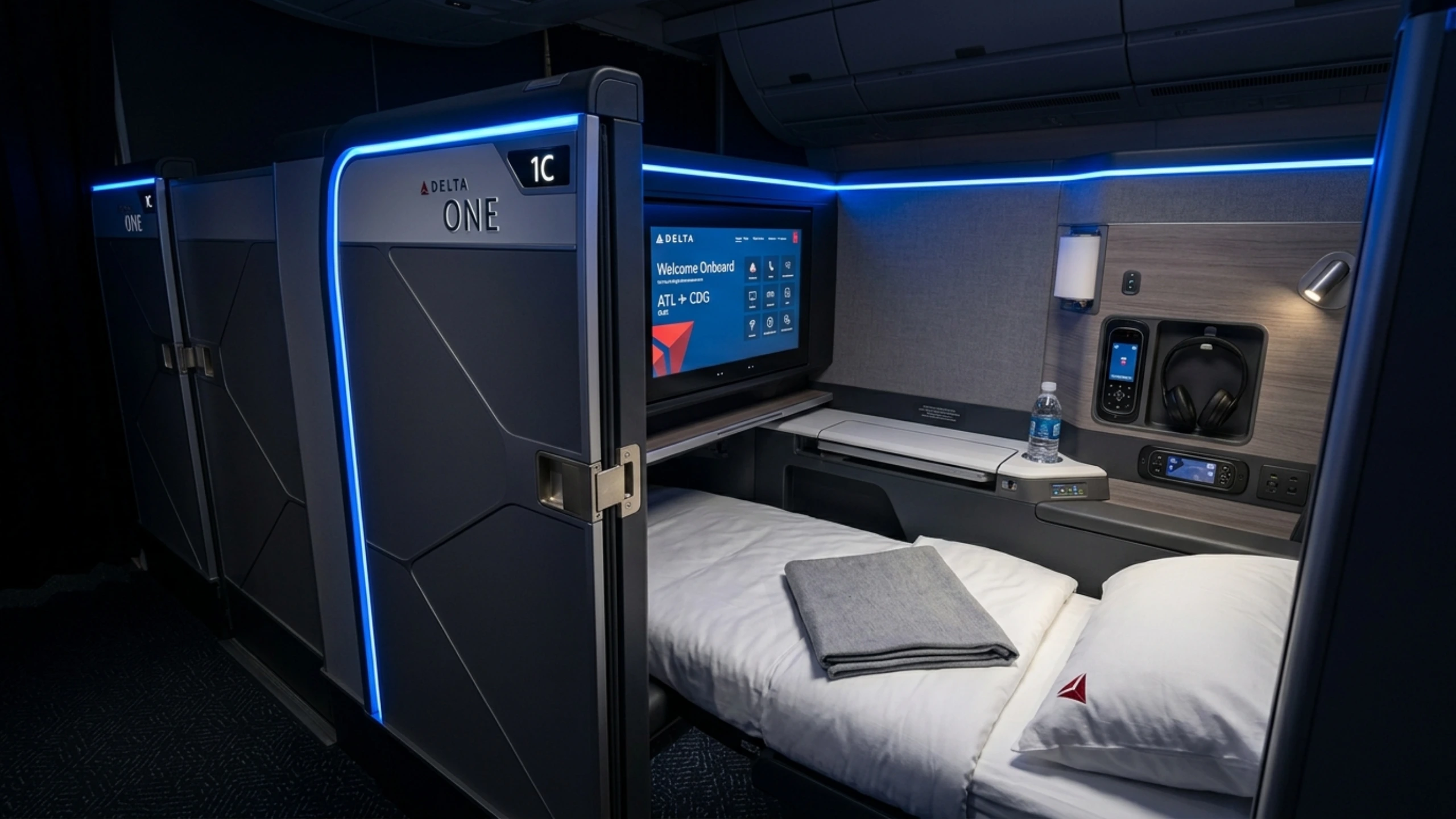
Delta also flies LAX-SYD nonstop on an A350, though seasonally and with less frequency than Qantas's daily service. The aircraft is the same generation, but Delta's business product (Delta One) uses a different seat — a suite with a sliding door, 1-2-1 layout, and honestly excellent bedding thanks to the Westin partnership.
Where Delta wins: the food and beverage program is more consistently American in style, which some travelers prefer, and Delta's app and rebooking flexibility tend to be smoother if your connecting flight in the US gets delayed. Where Qantas wins: frequency, an Australian-run cabin crew that seems to genuinely understand jet lag management (more on that below), and a lounge experience in LA that Delta's Sky Club simply can't match for this specific route.
If you're flying Los Angeles to Sydney business class during Delta's operating season (usually October through March) it's worth comparing both. But day in, day out, Qantas is the more reliable nonstop option, and it's the one BestBusinessClass.com books most often for this route.
Los Angeles (LAX)Sydney (SYD)
Qantas · Business Class
$4,200
roundtrip
What you'll actually pay
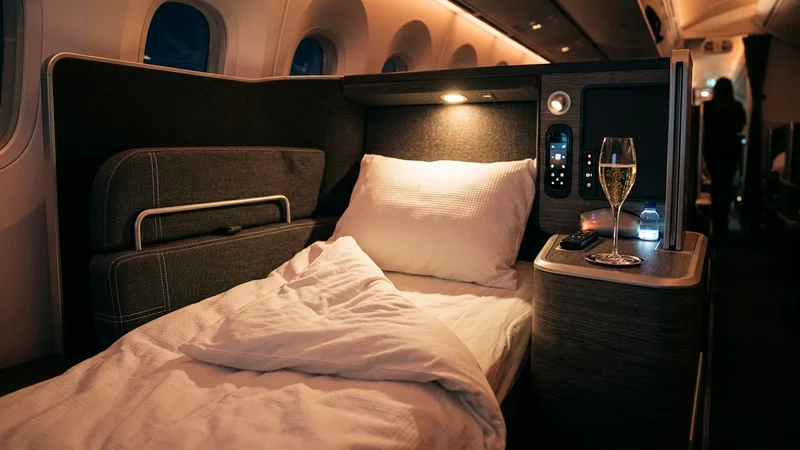
Published fares for this route are genuinely rough. Qantas.com and the usual booking sites will show you $6,500 to $12,000 round-trip depending on dates, with peak Australian summer (December, January) and Christmas travel periods pushing toward the top of that range.
That's a lot of money for a seat, even a very good one. This is exactly the kind of route where working with a consolidator makes a real financial difference, because the markup on published fares to Australia tends to be steeper than on European or Asian routes — there's simply less competition.
BestBusinessClass.com typically finds the same Qantas A350 business class seats for $3,000 to $5,500 round-trip, using consolidator fare classes that Qantas releases to travel agencies rather than the general public. I've booked clients into 2A on this exact aircraft for under $4,000 during a fare that was showing $9,200 on the airline's own site.
Why the price gap is so large
Qantas restricts a chunk of business class inventory to consolidator and agency channels specifically for long-haul routes like LAX-SYD, where demand is inelastic and price shopping is less common. That's the gap BestBusinessClass.com works in — same cabin, same aircraft, same seat, different fare bucket.
If you want to see what's currently available, browse current deals before you commit to a published fare. And if you're building out a broader Pacific itinerary, the Sydney city page has route-specific pricing worth comparing against.
Surviving 15 hours: the actual strategy
Here's the part most articles skip. A 15-hour flight isn't just a longer version of a 10-hour flight. It's long enough that your body will start treating it like actual time has passed, and how you manage that determines whether you land ready to function or completely wrecked.
How do you adjust to the time change on a flight this long?
The trick is committing to Sydney time almost immediately after takeoff. LAX to Sydney crosses the date line and roughly 17 to 19 hours of time difference depending on daylight saving in Australia, which is genuinely disorienting if you try to track both clocks in your head.
My approach: the moment the seatbelt sign turns off, I set my watch to Sydney time and start behaving accordingly. If it's night in Sydney, I eat lightly, skip the wine, and ask the crew to make up my bed early rather than waiting for the full meal service. Qantas crews on this route are used to this request — they'll usually set you up right after the first drink service if you ask.
Flights depart LAX in the evening, typically between 9:30pm and 10:45pm depending on the day, which actually works in your favor. You're already tired, it's already nighttime in LA, and you can get a legitimate six or seven hours of sleep in the first half of the flight before the cabin lights come up for the pre-arrival meal.
Pro Tip
Skip the champagne at boarding if you're serious about sleeping. Qantas pours a solid Australian sparkling on this route (usually a Tasmanian producer), but alcohol before a long sleep segment on a pressurized cabin hits differently and tends to fragment your sleep rather than help it.
Seat selection matters here too. If you're traveling solo, an aisle seat in the middle section (like 8D or 8G) gives you the ability to get up without waking anyone, which matters over 15 hours. If you're traveling as a couple, the middle pair seats let you keep the divider down for the whole flight, which some crews will forget to ask about unless you request it at boarding.
Is Qantas's Project Sunrise flight actually better than a connecting itinerary?
Honestly, it depends on what kind of traveler you are. If you sleep well on planes and hate the friction of a second security line and a rushed connection, nonstop wins easily. Fifteen hours of continuous sleep opportunity beats 11 hours plus a two-hour layover plus another four hours, every time.
But if you struggle to sleep upright even in a flat bed, a connecting itinerary through Auckland or Fiji breaks the trip into two manageable chunks and gives you a chance to walk around, eat a real meal at a gate, and reset. I've had clients specifically request the older routing through Fiji for this reason, even though it costs more time overall.
My honest take: the nonstop is better for most people, but it's not automatically better for everyone. Don't book it just because it's the new shiny option if you know upright sleep isn't your thing.
The Qantas First Lounge at LAX
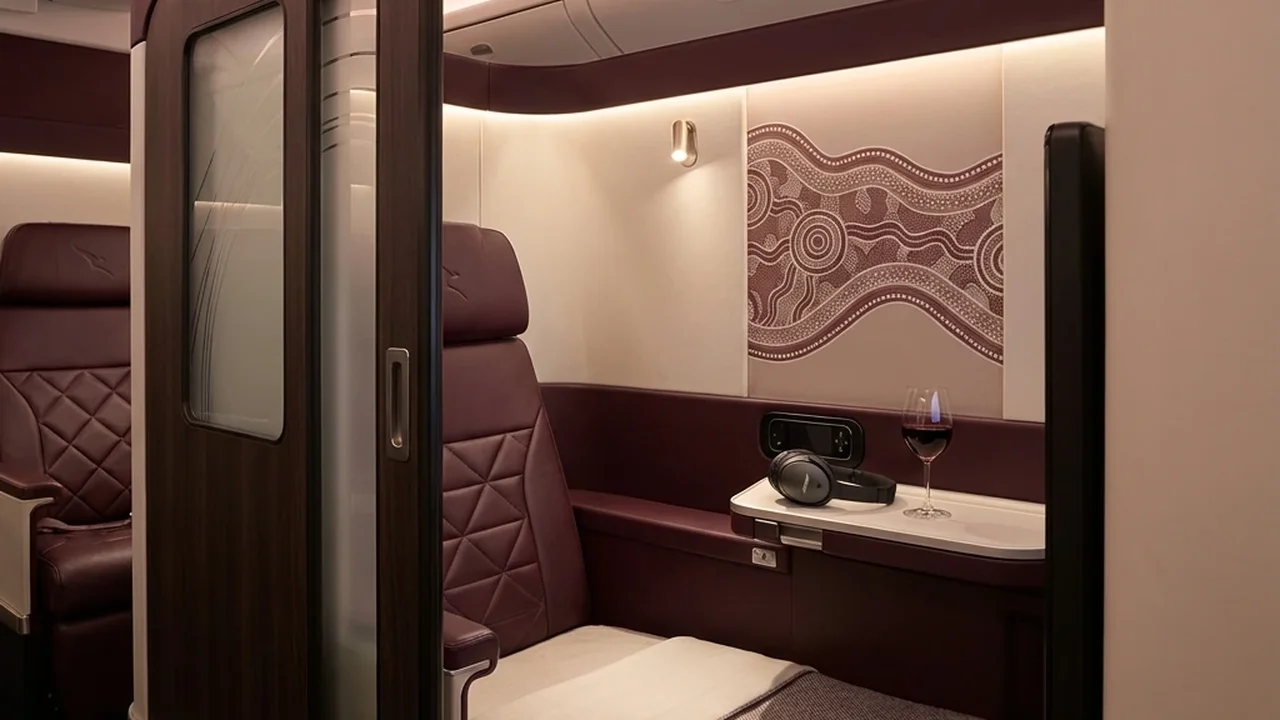
Before any of the in-flight stuff matters, you've got the lounge, and this is where Qantas genuinely delivers. The Qantas First Lounge at LAX, located near gate 123 in the Tom Bradley International Terminal, is one of the better lounges in the US for a route like this, and it's open to Qantas business class passengers on this specific flight, not just first class.
The signature element is the à la carte dining room, where you order off a printed menu and food comes out cooked to order rather than sitting under a heat lamp. Last time I flew this route I had a proper Wagyu steak sandwich with a side of hand-cut fries, and the kitchen also does a solid barramundi dish if you want to start easing into Australian menus before you land.
There's a full bar with a dedicated bartender, a decent wine list leaning Australian and Californian, and a shower suite situation that's better than most US lounges — six private shower rooms last I checked, with proper Aesop toiletries rather than generic hotel-brand stuff.
Where things fall short
The lounge gets busy before the two nightly LAX-SYD and LAX-MEL Qantas departures, and seating in the main lounge area can be tight during peak times around 9pm. I've waited close to 15 minutes for a shower slot on a full night. Get there early if showering before boarding matters to you.
Read our full Qantas business class review if you want the details on the airline's broader network and loyalty program, since the LAX lounge experience is really just the opening act for what the airline does well across the Pacific.
What arrival in Sydney actually feels like
You land at Sydney Kingsford Smith around 8am to 10am local time, depending on your exact departure day, which sounds civilized until you remember your body has just lived through 15 hours of manufactured nighttime and a full date change.
Immigration and customs at SYD move reasonably fast for business class arrivals — there's no dedicated fast-track lane specifically for the cabin, but the terminal isn't usually overwhelmed at this hour, and I've cleared in under 25 minutes most trips. Baggage tends to be quick too, since it's a widebody but not one of the mega A380 loads anymore.
The mistake most people make: going straight to bed at the hotel. Don't. Force yourself outside, get sun on your face, walk around Circular Quay or grab a coffee near the Opera House, and hold off on a real nap until closer to local evening. It's uncomfortable for the first day, but it resets your clock far faster than collapsing into a hotel bed at 11am and waking up at 4pm completely confused about what day it is.
Pro Tip
Book your first Sydney hotel night regardless of arrival time. Trying to save money by skipping the first night and going straight into a full day of meetings or sightseeing after 15 hours in the air is a mistake I've made once and never repeated.
If Sydney's your final stop rather than a jumping-off point for the rest of Australia, the Sydney city page breaks out current fare ranges and seasonal pricing patterns worth checking before you lock in dates, since December and January run considerably higher than the shoulder months of April through June.
Is this route worth booking in business class at all?
I get this question a lot, mostly from people wondering if they should just tough it out in premium economy and save the money for the actual trip. My answer, having done both: no, not on this specific route.
Fifteen hours in a cramped upright seat is a genuinely different experience from 15 hours flat. This isn't a six-hour transatlantic hop where premium economy can reasonably substitute for business. The length of this flight is exactly why the seat matters more here than almost anywhere else in the world.
That said, you shouldn't pay $10,000 for the privilege either. This is precisely the kind of route where a consolidator fare through BestBusinessClass.com changes the math entirely — the difference between $9,000 and $4,200 is often the deciding factor for whether people fly business at all on this route or grit their teeth in economy.
If you're weighing this trip against other long-haul options, our New York to London route guide is a useful comparison point for how much shorter flights price differently, and it's a good reminder that LA-Sydney sits in a category of its own for both duration and cost.
Call (855) 815-4774 for discounted Qantas business class fares to Sydney
Call NowThis article was created with AI assistance and reviewed by our editorial team.
#route-guide#sydney#los-angeles#lax#australia#oceania#qantas#ultra-long-haul#delta
Enjoy our content? Make us a preferred source on Google.
Business class deals, delivered
Join savvy travelers who receive exclusive deals, route tips, and insider knowledge. Free, weekly, no spam.
Unsubscribe anytime. We respect your inbox.
By submitting, you agree to our Privacy Policy and Terms of Service.
Ready to book your business class flight?
Our specialists access unpublished fares and save you up to 40% on premium cabins.
Related Routes
Business Class Deals Mentioned in This Article
You might also enjoy
Comparisons
Delta One vs United Polaris 2026: Which US Carrier Wins International Business Class?
10 min read
Route Guides
Minneapolis to Amsterdam Business Class: Delta & KLM Hub-to-Hub (2026)
12 min read
Airline Reviews
Delta One Suite Review 2026: America's Best Domestic-Carrier Business Class?
10 min read