Route Guides11 min readroute-guidebarcelonanyc
New York to Barcelona Business Class: Mediterranean Dreams (2026)
Flying New York to Barcelona in business class typically means connecting through Madrid on Iberia, or catching one of the seasonal nonstops that airlines run in peak summer months.
BC
BestBusinessClass Team
May 20, 2026
Share
New York to Barcelona Business Class: Mediterranean Dreams (2026)
Quick summary
Flying New York to Barcelona in business class typically means connecting through Madrid on Iberia, or catching one of the seasonal nonstops that airlines run in peak summer months. Published fares run $4,800 to $8,000 round-trip, but BestBusinessClass.com regularly books the same routes for $1,800 to $3,400 through consolidator fares. Iberia's new A350 product has genuinely changed the calculus on this route, and it's worth understanding before you book.
Barcelona doesn't get the nonstop love that London, Paris, or Rome get from New York. And that's actually part of what makes this route interesting to work with. Because there's no single dominant carrier hammering this city with premium metal every single day, the fare landscape is messier — which, if you know where to look, means more room to negotiate a real discount.
I've flown to Barcelona in business class four times in the past three years, twice on Iberia through Madrid and once on a seasonal nonstop that no longer exists in the same form. The city itself is worth the extra connection time. But the way you get there matters more than you'd think, and most people booking through Expedia or calling the airline directly are leaving money — and comfort — on the table.
The two real ways to fly business class to Barcelona
There are basically two paths for New York to Barcelona business class travel right now, and they're not equal.
Iberia via Madrid is the workhorse option. You fly JFK or Newark to Madrid on an Iberia widebody, connect at Madrid-Barajas, then hop a short intra-Europe flight down to Barcelona. Total travel time runs 10.5 to 12 hours depending on the connection, versus roughly 8 hours 15 minutes nonstop. It's not glamorous, but it's reliable, it runs daily, and Iberia's long-haul product has improved enough that the connection isn't the penalty it used to be. Seasonal nonstop service is the other option, and it's the one everyone wants but almost nobody can actually book when they need it. Carriers have experimented with direct JFK-BCN and Newark-BCN service in summer months, typically May through September, but capacity is thin and premium cabins sell out early. When it's running, it's the better experience — no connection, no Madrid layover roulette. When it's not running (October through April, mostly), you're back to connecting.$2,147
Average BestBusinessClass fare for New York to Barcelona business class
Is there a nonstop flight from New York to Barcelona in business class?
Sometimes, yes — but not year-round. Nonstop New York-Barcelona service has come and gone over the years depending on the carrier and the season, and it tends to concentrate in the summer travel window when transatlantic leisure demand to Spain peaks. LEVEL, the low-cost long-haul brand tied to IAG (Iberia's parent company), has operated seasonal Barcelona routes with a premium cabin that's worth understanding on its own terms — more on that below. Outside of peak season, your realistic option for business class is Iberia's Madrid connection, which runs every day of the year regardless of season.
If your travel dates are flexible, I'd actually recommend building your trip around whichever option is running rather than fighting to force a nonstop that isn't available on your dates. A well-timed Iberia connection through Madrid, done right, isn't a downgrade.
Iberia's business class renaissance is real
I want to be direct about something: Iberia used to have one of the worse business class products among the major European flag carriers. The old business class seats on their A340s were a 2-2-2 layout with no direct aisle access from every seat, which on an 8-hour flight is a real problem if you're stuck in a middle seat next to a stranger.
That's changed. Iberia has been rolling out A350-900s on its New York and other US routes, and the business class cabin on those aircraft is a proper reverse herringbone layout — every seat has direct aisle access, a closing door for privacy, and a flat bed that's actually flat, not the recliner-pretending-to-be-flat situation you get on older planes. It's not quite Qatar's Qsuite in terms of space, but it's a legitimate business class seat that competes with what Delta and American are running on their newest widebodies.
The catch: not every Iberia flight from New York is flying the A350 yet. Some routes and some days of the week still use older A330 or A340 equipment with the inferior 2-2-2 seats. This matters enormously for comfort, and it's exactly the kind of detail that gets lost when you're booking through a generic search engine that just shows you a price and a departure time.
Pro Tip
Before booking Iberia to Madrid, ask specifically which aircraft is flying that segment. The A350 business class is worth adjusting your dates for. The older A340 product, less so — especially on the long eastbound leg.
This is honestly one of the main reasons I'd point people toward a consolidator like BestBusinessClass.com rather than booking blind. Our team knows which Iberia flights out of JFK are running the new aircraft on a given week, and can steer you toward the right one instead of you finding out at the gate that you're on a 15-year-old plane.
What is Iberia business class like on the Madrid connection?
On the transatlantic leg, if you land the A350, you're looking at a proper flat-bed suite with a sliding door, decent noise isolation, and USB-C plus standard power at your seat. Food service on the New York-Madrid route has improved too — I had a genuinely good Iberian ham and manchego plate on my last flight, along with a solid Rioja list, which felt appropriate given where I was headed.
The Madrid-Barcelona connection is a different animal entirely. It's a 55-minute regional hop, often on an A320 or similar narrow-body, with a business class cabin that's really just economy seats with the middle one blocked and a curtain up front. Don't expect much — you get a coffee, maybe a small snack, and that's it. But it's short, and if your connection time is reasonable (I'd aim for 90 minutes to 2 hours at Madrid, not less), it's a minor inconvenience rather than a real problem.
What LEVEL's seasonal nonstop actually gets you
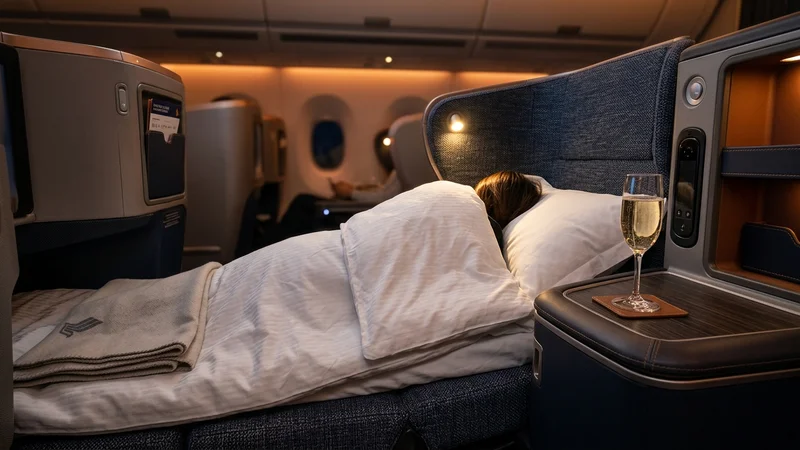
LEVEL operates as IAG's long-haul low-cost brand, and their premium cabin is worth understanding before you assume "business class" means the same thing across every airline.
LEVEL's premium cabin, when it's been running on transatlantic routes, is generally a recliner-style seat rather than a full flat bed — think a wider, more padded economy-plus seat with more recline and legroom, not a lie-flat suite. It's a fine way to fly 8 hours if your expectations are calibrated correctly, but if you're picturing an Iberia A350 suite, you'll be disappointed.
The upside is the nonstop routing and, often, a lower price point than full-service carriers even in premium cabins. The downside is the product itself and the fact that scheduling is seasonal and can change year to year based on demand and aircraft availability. I'd treat LEVEL as a solid option for saving time on the route, not as a luxury upgrade over the Iberia connection.
Don't assume 'business class' means the same seat everywhere
LEVEL's premium cabin and Iberia's A350 business class are not comparable products. One is a recliner seat with extra room. The other is a fully flat suite with a door. Confirm the aircraft and cabin type before booking, especially on seasonal or budget-adjacent carriers.
What published fares actually cost versus what you should pay
Here's where it gets useful. If you go directly to Iberia's website, or search ITA Matrix, or call the airline, published business class fares for New York to Barcelona typically land between $4,800 and $8,000 round-trip depending on season and how far out you're booking. Summer fares, especially anything touching festival season in June or the shoulder months around Easter, push toward the higher end.
BestBusinessClass.com works with consolidator fares and negotiated airline contracts that aren't available through normal retail channels, and on this specific route we're regularly quoting $1,800 to $3,400 round-trip for the same cabin, sometimes the same flight. That's not a marketing number — that's a reflection of how airlines sell unsold premium inventory through wholesale channels rather than let seats fly empty.
New York (JFK)Barcelona (BCN)
Iberia · Business Class
$2,380
roundtrip
The spread is wider on this route than it is on, say, New York to London, mostly because Barcelona sees less corporate travel demand and more leisure demand, and leisure demand is more price-sensitive and more seasonal. That volatility works in your favor if you book through the right channel and against you if you're paying rack rate.
How much does business class from New York to Barcelona actually cost?
The honest answer is: it depends enormously on when you book and through whom. Peak summer weekends (think mid-June through August) on Iberia's A350 routing can run $5,500-8,000 round-trip at published rates. Shoulder season — April, May, late September, October — tends to sit closer to $4,200-5,500 published. Through BestBusinessClass.com's consolidator contracts, we're typically able to get those same fares down into the $1,800-2,800 range in shoulder season and $2,600-3,400 in peak summer, which is a meaningful difference on a trip most people are booking for two people.
I'd also add: booking 2-3 months out tends to get better consolidator availability than booking either very last-minute or a full year in advance. Airlines release wholesale inventory in waves, and the sweet spot is usually somewhere in that middle window.
Barcelona El Prat's lounges: manage your expectations

Let's talk about the arrival and departure experience, because Barcelona-El Prat (BCN) is not going to blow you away with its lounges, and I'd rather tell you that now than let you find out standing in a mediocre buffet line.
The main business class lounge options at T1, where most Iberia and Star Alliance flights operate, are functional but not memorable. You'll find a Sala VIP lounge with the usual spread — some jamón, cheese, a few hot items that rotate, decent coffee, mediocre wine selection. It's fine for a couple hours before a flight. It is not a destination lounge the way something like the Cathay Pacific lounge in Hong Kong is.
If you're departing Barcelona for the return leg, my honest advice is to eat in the city before you head to the airport rather than count on the lounge for a real meal. Barcelona has some of the best food in Europe sitting right outside your hotel door — there's no reason to settle for airport catering when you could have had a proper lunch of pan con tomate and grilled octopus an hour earlier.
Pro Tip
If your return connects through Madrid, the Iberia lounges at Madrid-Barajas T4 are noticeably better than anything at Barcelona El Prat. If you have a choice of connection time, give yourself enough of a window at Madrid to actually use it rather than rushing through BCN's more limited options.
Is the Madrid connection worth it, or should you wait for a nonstop?
This is the question I get asked most, and my answer has become more nuanced over the years as Iberia's product has improved.
If your dates line up with a seasonal nonstop and the price is right, take it — saving 2-3 hours of total travel time matters, especially on the return red-eye when you're trying to sleep. But I wouldn't delay a trip or restructure your whole itinerary around chasing a nonstop that might not be running, or might be running with a recliner-only premium cabin that's a downgrade from what you'd get on Iberia's A350.
The Madrid connection, done on the right aircraft with a reasonable layover, is genuinely a good way to fly to Barcelona. You get a real flat-bed transatlantic experience, a short regional hop that barely counts as an inconvenience, and — if you build in enough time — the option to poke around Madrid's better airport lounges on the way through.
I'll say this too: connecting through Madrid isn't a bad way to see two Spanish cities in one trip if your schedule allows a stopover. Iberia doesn't charge extra for a modest layover, and spending 24 hours in Madrid before continuing to Barcelona has turned a couple of my trips into two-city visits rather than one.
Booking this route without overpaying
The core issue with New York to Barcelona business class is that it's a route without the intense daily competition of routes like New York-London or New York-Paris, and thin competition tends to keep published fares high. That's exactly the kind of route where working with a consolidator makes the most financial sense, because the difference between retail and wholesale pricing tends to be largest where competition is thinnest.
BestBusinessClass.com specializes in exactly this kind of gap — routes where the sticker price looks rough but negotiated fares bring it back down to something reasonable. We track which Iberia flights are running the A350, which weeks have better wholesale availability, and when it makes more sense to wait for a seasonal nonstop versus book the Madrid connection now.
If you want the specifics for Barcelona service, our Barcelona city page has current route options and fare ranges, and our Iberia review goes deeper on the A350 seat itself, aircraft-by-aircraft, if you want to know exactly what you're booking before you commit. You can also browse current deals if your dates are flexible and you just want to see what's moving right now.
Call (855) 815-4774 for discounted New York to Barcelona business class fares
Call NowBarcelona rewards a little extra planning on the flight side so you can spend your actual trip doing what the city's built for — long dinners, longer walks, and not thinking about airplanes at all.
This article was created with AI assistance and reviewed by our editorial team.
#route-guide#barcelona#nyc#jfk#spain#europe#iberia#american-airlines
Enjoy our content? Make us a preferred source on Google.
Business class deals, delivered
Join savvy travelers who receive exclusive deals, route tips, and insider knowledge. Free, weekly, no spam.
Unsubscribe anytime. We respect your inbox.
By submitting, you agree to our Privacy Policy and Terms of Service.
Ready to book your business class flight?
Our specialists access unpublished fares and save you up to 40% on premium cabins.
Related Routes