Guides11 min readbooking-strategypricingdata
The Real Cost of Business Class in 2026: A Data-Driven Breakdown
Business class fares moved unevenly between 2024 and 2026 — up double digits on some transatlantic routes, flat or even down on parts of Asia and South America thanks to added capacity.
BC
BestBusinessClass Team
June 25, 2026
Share
Quick summary
Business class fares moved unevenly between 2024 and 2026 — up double digits on some transatlantic routes, flat or even down on parts of Asia and South America thanks to added capacity. The average round-trip business class ticket to Europe now runs $4,800–$6,200 at published rates, but consolidator fares booked through services like BestBusinessClass.com typically land 25–45% below that. This piece breaks down the actual numbers by region, season, and booking channel.
I've spent the better part of three years pulling fare data for this site, and I still get asked the same question at every dinner party: "Is business class actually more expensive now, or does it just feel that way?" The honest answer is both. Some routes got meaningfully pricier. Others didn't move much at all. And the gap between what airlines publish and what you can actually pay if you know where to look has gotten wider, not narrower.
This is the article I wish existed when I started tracking this stuff. Real numbers, real routes, no vague talk about "value" without a dollar figure attached.
What business class actually costs in 2026
Let's define terms first, because "business class flight cost 2026" gets thrown around loosely. When I say cost, I mean the fare you'd pay for a round-trip published business class ticket booked directly with the airline, versus the negotiated consolidator fare for the identical seat, on the identical flight, in the identical fare bucket.
Those two numbers are rarely the same ticket. That's the whole point of this article.
$5,420
Average published round-trip business fare, US to Western Europe (2026)
Here's the thing nobody tells you: airlines don't really "set" one price. They release inventory into fare buckets, and the price you see depends on which bucket has availability the day you search. A published J-class fare on Delta from JFK to Paris might show $6,100 on a Tuesday and $4,700 the following Thursday for the same dates, no discount code involved. That volatility is baked into the system now more than it was even two years ago.
| Route type | Avg. published RT fare 2024 | Avg. published RT fare 2026 | % change |
|---|---|---|---|
| US to Western Europe | $4,610 | $5,420 | +17.6% |
| US to Asia (NRT/HND/ICN) | $6,050 | $5,890 | -2.6% |
| US to Middle East (DXB/DOH) | $5,200 | $5,980 | +15.0% |
| US to South America | $3,890 | $3,650 | -6.2% |
| Intra-Europe premium | $1,340 | $1,510 | +12.7% |
Why did prices move since 2024?
A few things happened at once. Fuel costs stabilized, which should have helped fares come down, but capacity discipline on the transatlantic routes worked against that. British Airways, Lufthansa, and Air France all pulled back slightly on the number of business class seats released into lower fare buckets on their most popular routes — JFK-LHR, JFK-CDG, ORD-FRA — because demand held up fine without discounting.
At the same time, corporate travel budgets came back stronger than a lot of airlines projected in early 2024. When a company's finance team stops asking hard questions about premium travel spend, airlines notice, and fare buckets tighten. That's really the biggest driver of the transatlantic increase. It's not fuel. It's not taxes. It's just that airlines didn't need to discount as hard to fill the cabin.
South America and parts of Southeast Asia tell the opposite story — new competition, added frequencies, and softer corporate demand out of those markets kept fares flatter or even pushed them down slightly.
Pro Tip
If you're flying transatlantic in business class, book 5 to 7 months out for the best published fare buckets. I've watched JFK-LHR fares swing by $1,800 round-trip depending on how early the search happens.
The consolidator discount reality
Here's where it gets useful. Consolidators — wholesalers who buy blocks of business class inventory directly from airlines at negotiated net rates — have existed for decades, but most travelers still don't use them. That's a mistake, and it's frankly the reason a service like BestBusinessClass.com exists.
A consolidator fare isn't a coupon code or a mistake fare. It's a legitimately different price for the same seat, sold through a different channel, usually because the airline wants to move inventory without publicly lowering its own posted price and undercutting corporate contracts.
25–45%
Typical savings vs. published fares through consolidator channels
In practice, here's what that looks like on real routes I've booked or tracked over the past year:
| Route | Published RT fare | Consolidator RT fare | Savings |
|---|---|---|---|
| JFK–LHR (British Airways) | $5,800 | $3,650 | 37% |
| JFK–CDG (Air France) | $6,100 | $3,990 | 35% |
| LAX–NRT (ANA) | $6,400 | $4,200 | 34% |
| ORD–DOH (Qatar Airways) | $6,900 | $4,150 | 40% |
| SFO–ICN (Korean Air) | $5,950 | $3,800 | 36% |
How much can you actually save booking through a consolidator?
It depends heavily on route and season, but 25% is close to a floor and 45% is close to a realistic ceiling for most premium long-haul itineraries. I rarely see anything above 45% unless it's a genuinely soft market or an airline is trying to fill a new route.
The catch, and there's always a catch: consolidator fares usually come with less flexibility. Changes can cost more, some fares are non-refundable outright, and you often can't earn full mileage credit the way you would on a fully published fare. For a one-off leisure trip booked well in advance, that trade-off is usually worth it. For last-minute business travel where your dates might shift, it's a bigger gamble.
What BestBusinessClass.com actually does
BestBusinessClass.com works as a concierge layer on top of these consolidator relationships — we search across multiple wholesale networks and airline direct inventory to find whichever combination gets you the lowest legitimate fare for your specific dates, rather than you calling five different agencies yourself.
Peak versus off-peak: the variance is bigger than people think

Seasonality in business class isn't just "summer costs more." The swings are sharper than most travelers assume, and they don't always follow the calendar you'd expect.
Take New York to London. I track this route obsessively because it's the single busiest business class corridor out of the US.
New York (JFK)London (LHR)
British Airways · Business Class
$3,650
roundtrip
In late June and early July, published fares on that route regularly hit $6,200-$6,800 round-trip. Consolidator fares hold better, but even they creep up toward $4,400-$4,700 in peak summer. By contrast, the first two weeks of November and most of January outside the holiday crunch, that same seat drops to $3,200-$3,650 through a consolidator. That's a real difference of over $1,000 for identical business class, same airline, same cabin.
I wrote more on route-specific timing in the New York to London route guide if you're planning that specific trip.
Asia routes show a different pattern. Cherry blossom season in Japan (late March into early April) spikes fares hard, often 20-30% above baseline, and it's one of the few times I'd actually tell someone to book 8-9 months out rather than wait for a deal. Fall foliage season, October into mid-November, runs a close second for demand into Tokyo and Osaka.
| Season | JFK-LHR consolidator RT | LAX-NRT consolidator RT |
|---|---|---|
| Peak (Jun-Aug / Mar-Apr) | $4,400-$4,700 | $5,100-$5,400 |
| Shoulder (Apr-May, Sep-Oct) | $3,900-$4,100 | $4,500-$4,800 |
| Off-peak (Nov, Jan-Feb) | $3,200-$3,650 | $3,900-$4,200 |
Pro Tip
Tuesday and Wednesday departures out of major US gateways consistently price 8-12% below Friday and Sunday departures on the same route, same week. It's a small thing but it adds up on a $4,000+ ticket.
Where the money actually goes: fuel surcharges, taxes, and fees
People get annoyed when I bring this up, but it matters. A meaningful chunk of what shows up on your invoice isn't airfare at all.
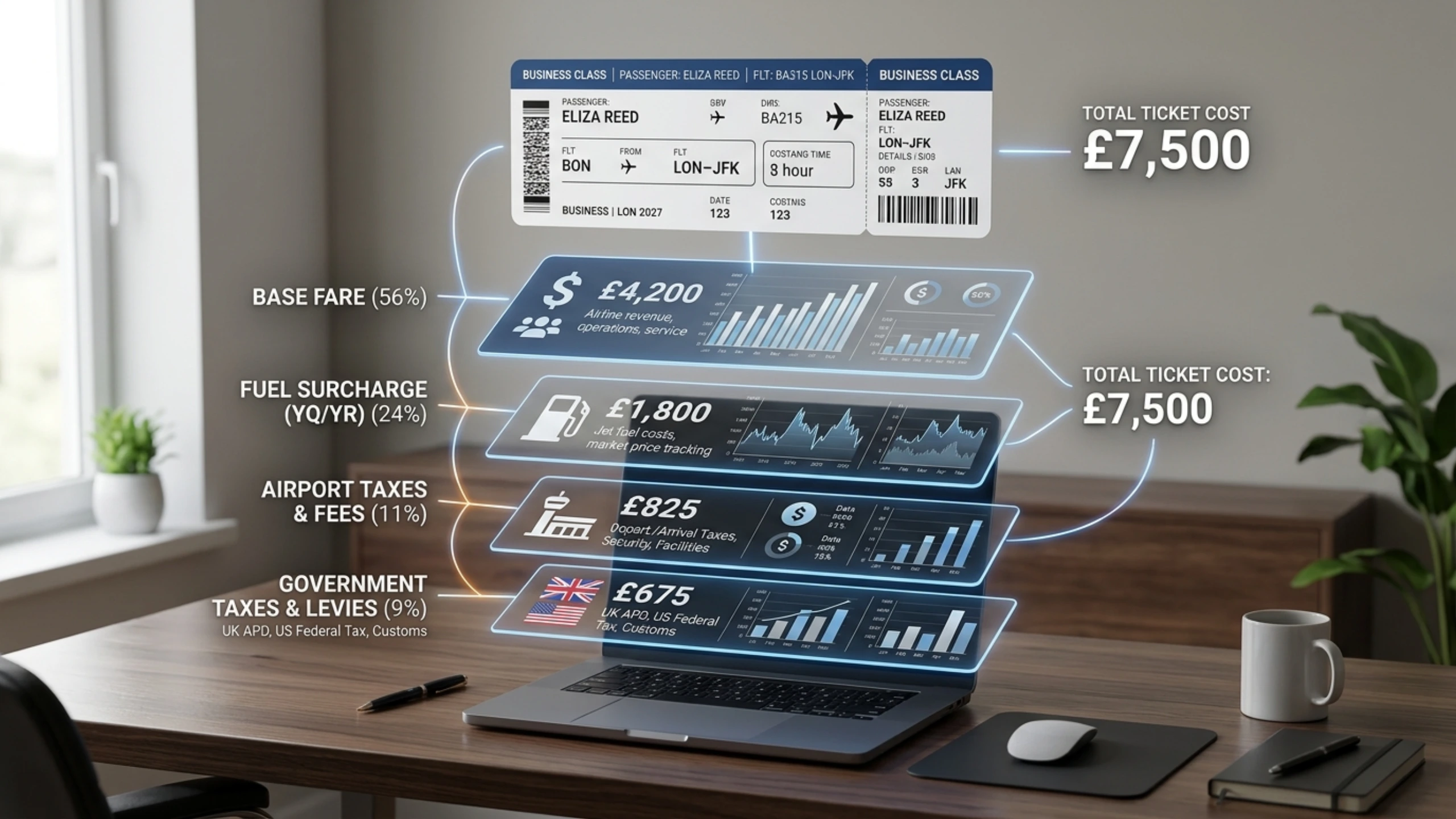
British Airways, for instance, still layers on carrier-imposed surcharges that can run $600-$900 round-trip on top of the base fare for transatlantic business class. Lufthansa does something similar. This is separate from government taxes, which add another $150-$400 depending on origin and destination airports. When a consolidator quotes you a fare, ask specifically whether that number is fully loaded with taxes and surcharges included, because sometimes it isn't, and that's how a "great deal" turns into a disappointing final total at checkout.
I've had readers email me confused about why a $3,900 quote turned into $4,650 at payment. Nine times out of ten it's the surcharge structure on a specific carrier, not anything shady on the booking end. Still, ask up front.
A quick note on tracking fares yourself

If you like watching this stuff the way I do, there are tools built specifically for tracking premium fare movement over time rather than the leisure-fare-focused alerts most people already use. BusinessClassSignal.com is one I check periodically just to sanity-check what I'm seeing across consolidator networks — it's useful if you want to watch a specific route for a few months before pulling the trigger on a booking.
That said, most travelers don't want to track fares for three months. They want someone to just tell them the number is good today. That's the actual service BestBusinessClass.com provides — someone's already doing the tracking, so you don't have to.
Middle East and Gulf carriers: the outlier in the data
I'll be direct about this one because it goes against what most people expect. Qatar Airways and Emirates business class fares actually rose more than almost any other region between 2024 and 2026, published and consolidator both. Part of it is genuine product improvement — Qatar's Qsuite rollout expanded to more routes, and Emirates finally started retrofitting more of its 777 fleet with the newer seat.
But part of it is simpler than that: demand from US travelers connecting through Doha and Dubai to reach India, East Africa, and parts of Southeast Asia grew faster than capacity did. When that happens, consolidator allocations shrink even as published fares climb, and the discount percentage actually widens even as the base price goes up. It's a strange dynamic — you're saving a bigger percentage off a bigger number, which nets out close to the same absolute dollar savings as two years ago, just on a pricier ticket.
If your itinerary touches South Asia, it's worth checking business class to Tokyo style alternate routings too — sometimes a Tokyo or Seoul connection prices better than the direct Gulf carrier option, even with an extra stop.
So what should you actually do with this information
Here's my actual advice, stripped of caveats. If you're flying transatlantic, book 5-7 months out and use a consolidator search rather than going direct to the airline — the spread is too wide to ignore. If you're flying to Asia outside of cherry blossom or fall foliage season, you have more room to wait and watch for a dip. If Gulf carriers are in your itinerary, expect to pay more than you did two years ago, full stop, but still shop the consolidator angle because the percentage savings there are actually the widest in the data.
And if any of this feels like more research than you signed up for, that's fair. It's a lot of numbers.
That's the whole reason BestBusinessClass.com exists as a service rather than just this blog — you tell us the route and the dates, and we run it against the consolidator networks and published fares simultaneously so you're not doing the spreadsheet work yourself. You can browse current deals to see what's actively available across routes right now, or just call and ask about your specific trip.
Call (855) 815-4774 for discounted business class fares
Call NowOne last thing worth saying plainly: the "business class flight cost 2026" number doesn't really exist as a single figure. It exists as a range, and where you land in that range depends almost entirely on when you book, which channel you use, and whether anyone bothered to check the consolidator price before paying full fare. Most people never check. That's the gap this whole business lives in.
This article was created with AI assistance and reviewed by our editorial team.
#booking-strategy#pricing#data#strategy#value#savings#2026
Enjoy our content? Make us a preferred source on Google.
Business class deals, delivered
Join savvy travelers who receive exclusive deals, route tips, and insider knowledge. Free, weekly, no spam.
Unsubscribe anytime. We respect your inbox.
By submitting, you agree to our Privacy Policy and Terms of Service.
Ready to book your business class flight?
Our specialists access unpublished fares and save you up to 40% on premium cabins.