Travel Tips11 min readairline-foodwinedining
Best Business Class Dining in the Sky 2026: Airlines Ranked by Food & Wine
Singapore Airlines still makes the best business class food and wine of any carrier flying today, thanks to its Book the Cook pre-order program and a wine list vetted by three independent sommeliers.
BC
BestBusinessClass Team
July 14, 2026
Share
Quick summary
Singapore Airlines still makes the best business class food and wine of any carrier flying today, thanks to its Book the Cook pre-order program and a wine list vetted by three independent sommeliers. ANA and Air France round out the top three, with genuinely restaurant-quality kaiseki and Bordeaux-driven French cooking respectively. Below that, quality drops off fast, and a few "premium" airlines are coasting on reputation alone.
I've eaten business class meals on close to 40 airlines over the last decade, and most of them are forgettable. Reheated protein, a sad little salad, a wine list picked by a purchasing department instead of a person who actually tastes wine. But a handful of airlines have figured out that food and wine is one of the only parts of the flight passengers actually remember, and they've put real money and real chefs behind it.
This is my ranking for 2026, based on meals I've eaten in the last 18 months, not press kit menus. I flew most of these routes specifically to compare them, and I called in favors with a few crew members to understand what's actually loaded onto the aircraft versus what's promised on the website.
What "best business class food and wine" actually means
When people ask me what the best business class food and wine looks like, I tell them it's not about the fanciest ingredients. It's about three things: whether the kitchen on the ground can actually execute the menu the airline promises, whether the wine list was chosen by someone with a palate rather than a spreadsheet, and whether you have any control over what and when you eat.
A lot of airlines nail one of those and completely whiff on the other two. Emirates throws money at ingredients but the execution is inconsistent flight to flight. Delta has ambition but the galley crew can't always pull off what the menu card promises. The airlines at the top of this list get all three right, most of the time.
How I ranked these ten airlines
I weighted four things: cuisine quality and consistency, the wine program (both the list and how it's actually poured onboard), whether you can pre-order, and how well dietary restrictions are handled without you having to fight for it. Singapore Airlines and ANA scored high across the board. A few airlines near the bottom are still perfectly pleasant, they just don't compete with what's happening up top.
60+
Dishes available through Singapore Airlines' Book the Cook pre-order menu
The ranking: 10 airlines, best to worst
1. Singapore Airlines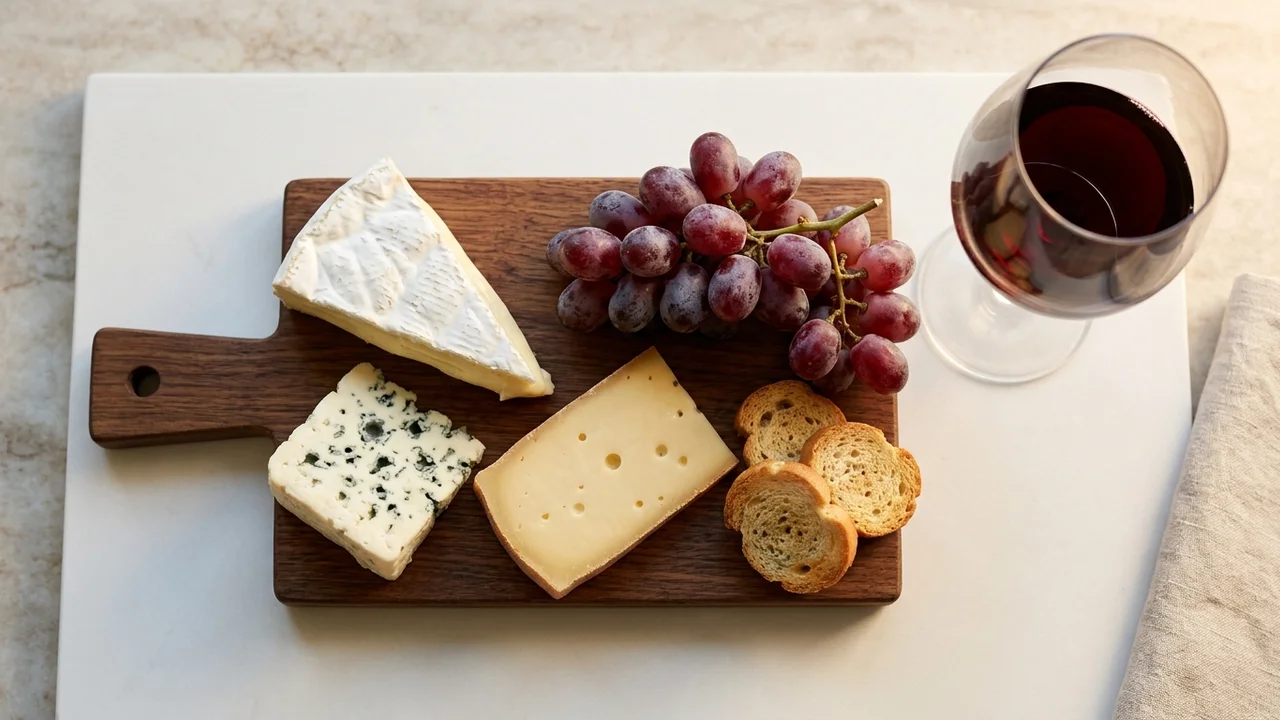
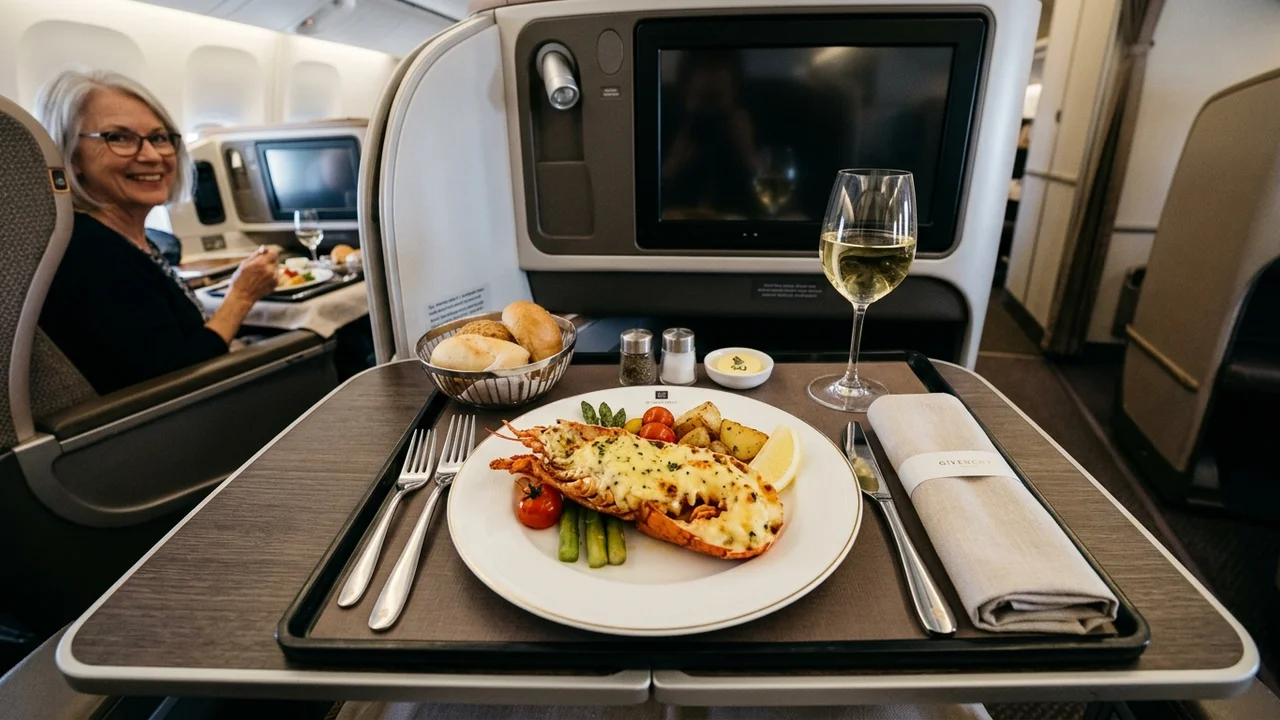
Nobody else is close. Singapore's Book the Cook program lets you choose your main course from over 60 dishes up to 24 hours before departure, everything from Lobster Thermidor to Hainanese chicken rice, and it actually arrives looking like what you picked. The tableware is Givenchy-branded, which sounds like a marketing gimmick until you're eating off it and realize the plates are genuinely well designed for a moving aircraft.
The wine list is where Singapore really separates itself. Three independent sommeliers, not one house consultant, select the program each year, and it shows in the range. I've had a 2017 Chassagne-Montrachet in Singapore Suites that most restaurants would charge $200 a bottle for. My full take is in the Singapore Airlines business class review, but the short version is: this is still the benchmark.
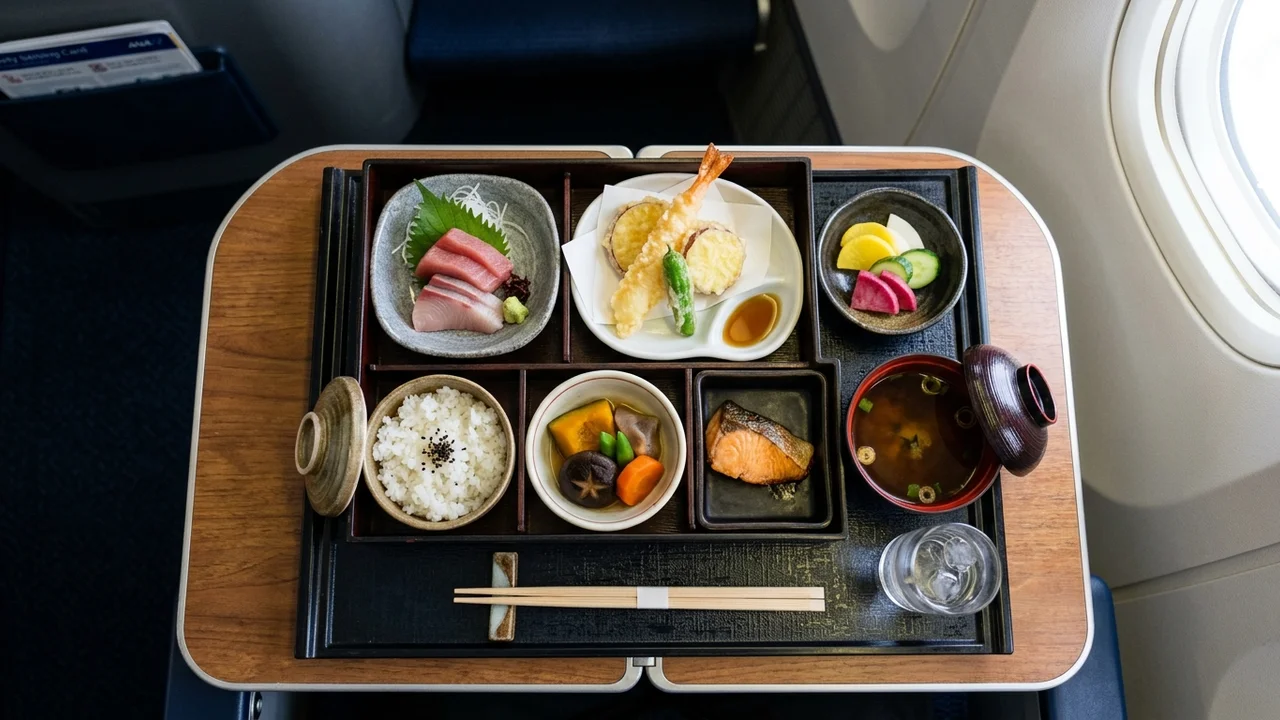
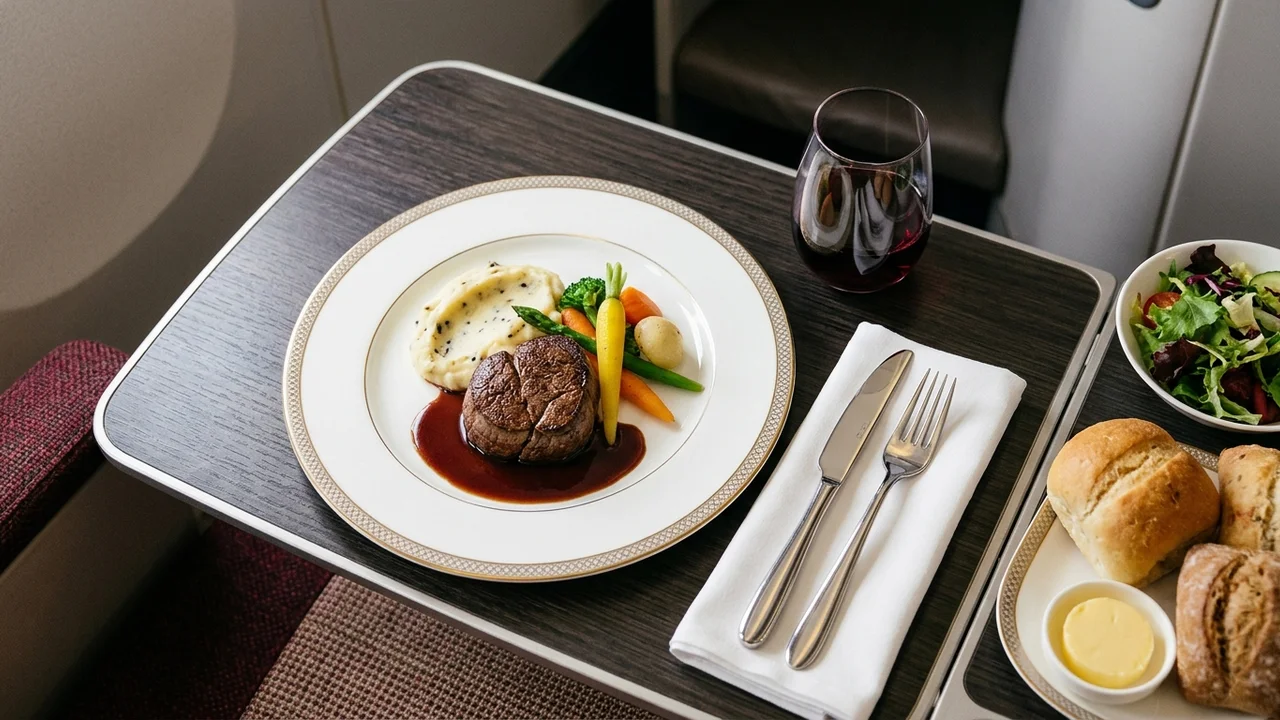
2. ANAANA's Japanese kaiseki service is the closest I've come to eating at an actual restaurant at 38,000 feet. Multi-course, seasonal, presented in lacquered bento-style trays with real attention to how the colors and textures work together. There's a Western alternative if kaiseki isn't your thing, usually something like a beef fillet with red wine reduction, competently done but clearly the B-option.
The sake program deserves more attention than it gets. ANA pours junmai and junmai ginjo selections that change seasonally, and the crew will actually walk you through what pairs with what if you ask. I go into more detail in the ANA business class review. This is the airline I recommend most often to people flying business class to Tokyo who actually care about the meal.
3. Air FranceThis is the most civilized meal in the sky, full stop. Air France's wine program is curated by Paolo Basso, a former World's Best Sommelier, and it's Bordeaux-forward in a way that feels genuinely French rather than performative. I've had a 2016 Saint-Émilion Grand Cru on a Paris to New York flight that I'd have happily paid restaurant prices for.
The food matches the ambition. Proper brasserie mains, duck confit, a beef bourguignon that doesn't taste like it spent six hours in a cardboard box, and a cheese course with a small selection of French cheeses served at something close to room temperature. Details are in my Air France business class review. If you're on a transatlantic route and food matters to you, this is the airline to chase.
4. Qatar AirwaysQatar's biggest advantage is flexibility. On most long-haul routes you can order from the menu whenever you want, not just at the two scheduled service windows, which sounds minor until you're on a 16-hour flight and you actually want dinner at hour 11 instead of hour 2. The Nobu collaboration brought some genuinely good dishes into rotation, including a black cod with miso that's better than what a lot of actual Nobu locations serve.
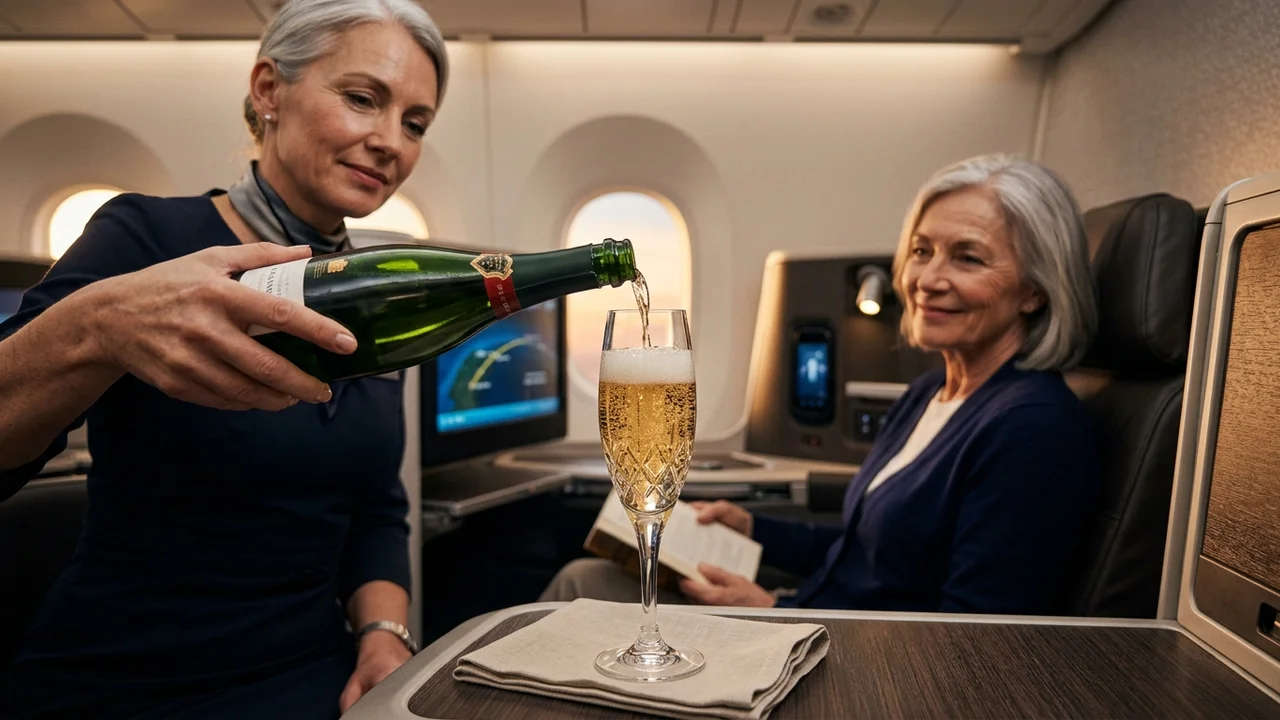
Champagne is generous here, and it's usually something respectable rather than an airline house pour. I cover the seat and service side more in the Qatar Airways business class page. The dining program is strong enough that it alone justifies flying them on routes where the seat hardware is a step behind competitors.
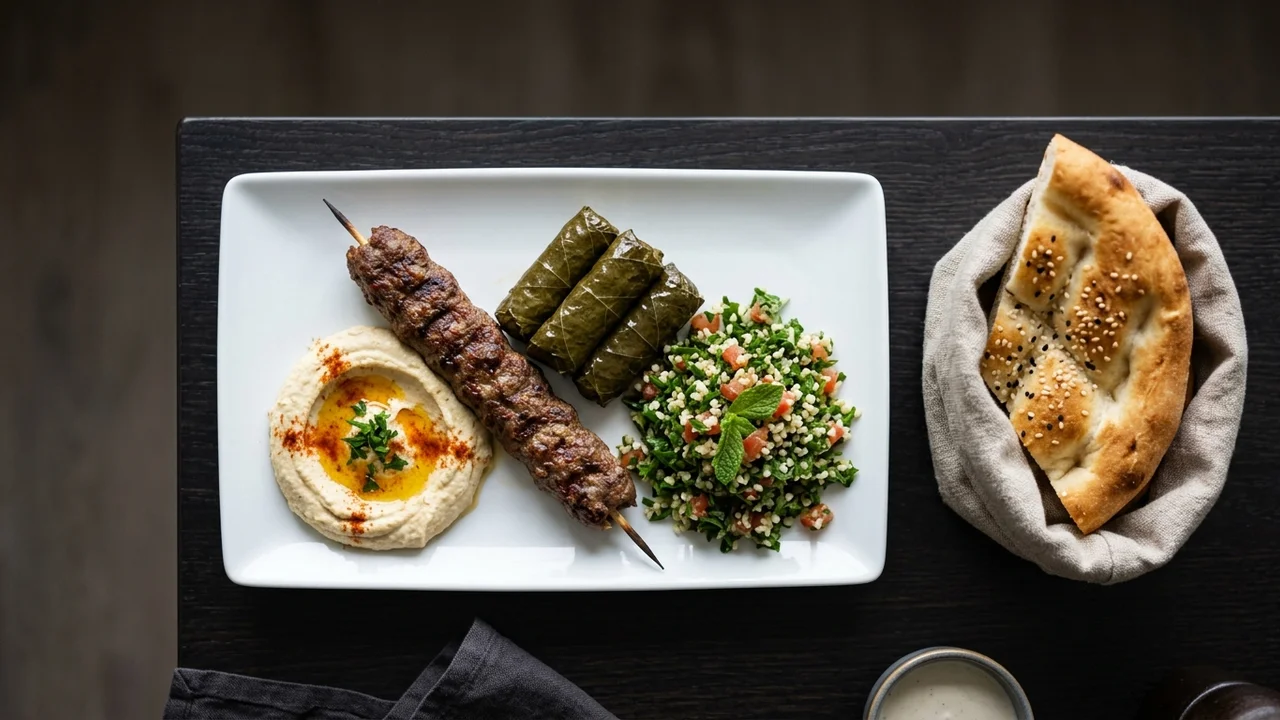
5. Turkish AirlinesTurkish leans on DO&CO catering, the same Austrian company that supplies several of the airlines higher on this list, and on longer widebody flights they actually put a flying chef in the galley. The meze spread, hummus, muhammara, a proper cacık, rivals what I've had at good restaurants in Istanbul, and the kebab options hold up surprisingly well reheated at cruising altitude.
Full breakdown is in the Turkish Airlines business class review. The wine list is the weak point, competent but not exciting, but the food alone makes this a top-five program.
6. EmiratesEmirates throws real money at ingredients and it shows in the menu descriptions. Regionally-inspired dishes change by route, the Champagne budget is generous (you'll often see Moët or better poured without much prompting), and portions are large. My honest issue is consistency: I've had excellent meals on Emirates and I've had ones that felt phoned in, sometimes on the same route a few months apart.
More detail on the seat and cabin experience is in the Emirates business class review. This is quantity and ambition over subtlety, which works fine for some travelers and less well for others.
7. Cathay PacificCathay's dim sum program has genuinely improved over the last two years, and the tea service is one of the most underrated parts of any airline's onboard experience. Someone actually trained the crew on brewing times and leaf selection, which is more than most carriers bother with.
The real standout, if your itinerary allows it, is The Pier lounge in Hong Kong, where the noodle bar makes fresh wonton noodles to order. It's better than most of what's served on the plane itself, honestly.
8. LufthansaLufthansa doesn't get enough credit for its bread basket, which is the best in business class anywhere, full stop. The rest of the meal is solid German-international cooking, schnitzel, good sausages, occasionally a surprisingly well-executed pasta course. The Franconian wine list is a nice regional touch that most American travelers have never heard of and end up liking.
Nothing here is flashy. It's dependable, and on a continent where a lot of European carriers have quietly cut catering budgets, dependable counts for something.
9. DeltaDelta's partnership with chefs Jon Shook and Vinny Dotolo brought some legitimately interesting menu concepts onboard, short rib, a good grain bowl, dishes that don't taste like airline food on paper. The problem is execution. I've had the same dish taste completely different on two flights a month apart, which tells me the galley training isn't consistent across the fleet.
It's ambitious, and I respect that Delta is trying to compete with international carriers on food rather than just seat hardware. It just doesn't land every time.
10. EVA AirEVA's Taiwanese comfort food is genuinely good, and the Din Tai Fung influence on some of the dumpling and noodle dishes is real, not marketing. But it's predictable. You mostly know what you're getting before you order, which isn't a bad thing on a long flight, it's just not exciting.
Pre-ordering tricks that actually change your flight
Should you pre-order your meal before you fly?
Yes, and it matters more than most travelers realize. Singapore's Book the Cook and similar programs on ANA and Emirates let you lock in your main course days in advance, which almost always means the kitchen prepared your specific meal rather than pulling from whatever's left in the galley cart.
Pro Tip
Pre-order 24 to 48 hours before departure whenever the airline offers it. Popular dishes on Singapore Airlines' Book the Cook menu run out on high-demand routes, and crews load a limited number of each option.
Dietary restrictions get handled far better through pre-order systems too. If you're gluten-free, kosher, or need a low-sodium meal, submitting it 48-plus hours ahead through the airline's website almost always produces a better result than telling the crew onboard and hoping.
Don't wait until boarding
Special meal requests made after check-in are often denied outright. Most airlines require dietary and religious meal requests at least 24 hours before departure, and some, like Emirates, require 48 hours for certain categories.
Timing your meals so you land human
What's the smartest way to eat on a long-haul flight?
Eat light on the first meal, especially if it's a dinner service right after a daytime departure. A full multi-course meal with wine right when you board just guarantees you'll feel sluggish for the next several hours. I usually order the lighter option, skip a course, and save the appetite for later.
Skip the mid-flight snack unless you're genuinely hungry. Most business class cabins have some kind of snack basket or on-demand light bite between meal services, and taking it just because it's there disrupts your sleep window on longer flights.
Eat the full breakfast before landing. This is the meal worth committing to, since you're about to be upright and moving for the rest of the day anyway. Air France and ANA both do breakfast well, with a proper croissant and coffee on the former and something closer to a light rice-based meal on the latter.
New York (JFK)London (LHR)
Air France · Business Class
$2,450
roundtrip
If you're booking a transatlantic route specifically around the meal service, the New York to London route guide breaks down which carriers on that specific corridor are worth the extra cost for the cabin experience alone.
Dietary accommodations, ranked honestly
Singapore and ANA handle special meals with the least friction, mostly because their pre-order systems are built around choice rather than a single "special meal" category. You're picking from real alternatives, not a generic vegetarian tray that got loaded as an afterthought.
Qatar and Air France are close behind. Both will accommodate vegan, gluten-free, and religious dietary needs well if you submit requests early, though Air France's vegetarian options can lean heavily on pasta if you're flying a shorter European route.
Emirates and Turkish are fine but less flexible in practice. I've had special meals arrive late in the service on both, after the crew worked through the standard cart first. Delta's dietary accommodation is inconsistent for the same reason its regular menu is inconsistent: execution varies by crew and by aircraft.
Booking the seat that comes with the meal
None of this matters if you're paying full fare for a seat you could have gotten for 40% less through the right channel. This is where BestBusinessClass.com actually earns the call. We work through consolidator fares and airline contracts that aren't published on the airlines' own sites, which means you can often book Singapore Suites or ANA's The Room for meaningfully less than list price.
I'd also point out that the food program is one more reason to actually browse current deals before booking directly with an airline. A lot of travelers default to whichever carrier flies their route nonstop without checking whether a one-stop itinerary on a better airline, with a better meal service, actually works out cheaper and only adds an hour or two to the trip.
BestBusinessClass.com specializes in exactly this kind of routing and fare work, matching the seat and the airline to what you actually care about, whether that's flat-bed comfort, mileage earning, or, in this case, not eating something sad out of a foil tray for 14 hours.
Call (855) 815-4774 for discounted business class fares on Singapore, ANA, Air France and more
Call NowI still think about that Chassagne-Montrachet on Singapore more than I think about most restaurant meals I've had this year. That's a strange thing to say about airline food. But it's also exactly why this ranking exists.
This article was created with AI assistance and reviewed by our editorial team.
#airline-food#wine#dining#ranking#qatar-airways#singapore-airlines#ana#air-france#turkish-airlines#emirates
Enjoy our content? Make us a preferred source on Google.
Business class deals, delivered
Join savvy travelers who receive exclusive deals, route tips, and insider knowledge. Free, weekly, no spam.
Unsubscribe anytime. We respect your inbox.
By submitting, you agree to our Privacy Policy and Terms of Service.
Ready to book your business class flight?
Our specialists access unpublished fares and save you up to 40% on premium cabins.
Related Routes