Travel Tips14 min readtipssleepred-eye
Business Class Red-Eye Survival Guide: How to Actually Sleep at 40,000 Feet
Sleeping well on an overnight business class flight comes down to what you do before you board, not just the seat you're in.
BC
BestBusinessClass Team
August 2, 2026
Share
Quick summary
Sleeping well on an overnight business class flight comes down to what you do before you board, not just the seat you're in. The biggest levers are timing your meal (eat light, skip the heavy main), setting up your bed before service starts, and picking the right sleep aids for your body. Qatar, Singapore, ANA, and Delta One consistently deliver the best sleep setups — but even a mediocre business class red-eye can work with the right approach. This guide covers exactly how, drawn from probably 60-plus overnight business class flights.
I used to think a lie-flat seat was enough. Book business class, recline to 180 degrees, wake up in London feeling like a new person. That's the fantasy the airlines sell you in their ads with the soft lighting and the model who's clearly never actually slept sitting upright at 39,000 feet.
The reality is messier. You can spend $4,000 on a business class ticket and still land feeling like garbage because you drank two glasses of champagne, ate a full three-course meal at 11pm, and never adjusted your seat out of the upright "greeting" position until the flight attendant told you to for landing. I've done that flight. It's miserable.
What follows is basically the checklist I run through on every red-eye now, refined over a few hundred segments and a lot of trial and error. Some of it is intuitive. Some of it took embarrassingly long to figure out.
What actually happens to your body on a red-eye
Before the tactics, it helps to know what you're fighting. Cabin pressure at cruising altitude is equivalent to being at roughly 6,000 to 8,000 feet of elevation, which mildly reduces the oxygen in your blood and makes you feel more fatigued and more dehydrated than you would at sea level. Combine that with cabin humidity that typically sits below 20% — drier than most deserts — and you've got a body that's already working harder than normal before you factor in trying to sleep sitting in a seat, even a nice one.
This is why the "just have a drink and pass out" strategy backfires so often. Alcohol dehydrates you further, and dehydration is already your baseline problem. It also disrupts REM sleep, so even if you do nod off, you're getting shallower, more fragmented rest.
6,000-8,000 ft
Effective cabin altitude at cruise, even in business class
Before you even get to the airport
Eat a real meal before you leave the house, or at least before you get to the lounge. Lounge food is almost universally heavy — think pasta, curry, hot buffet items designed for volume, not digestion. Eating a big lounge meal right before a flight where you're also planning to eat a business class dinner at cruising altitude means you're doubling up on food your body doesn't need before trying to sleep.
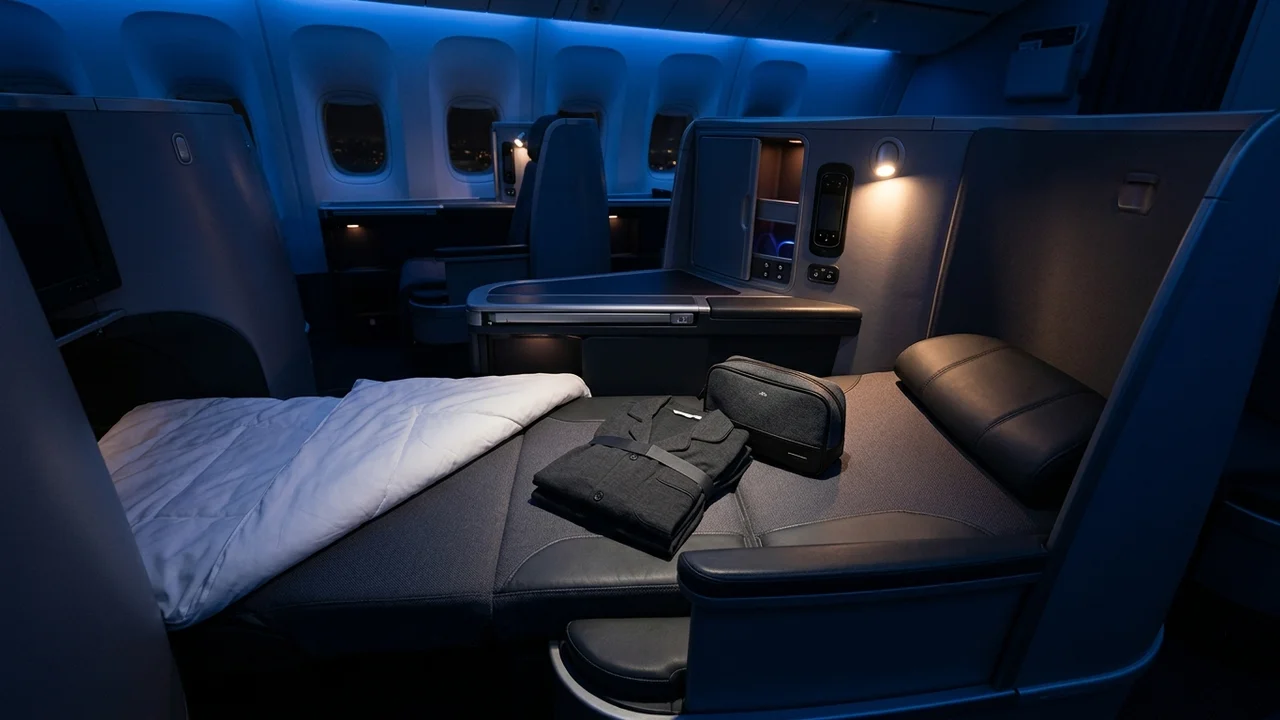
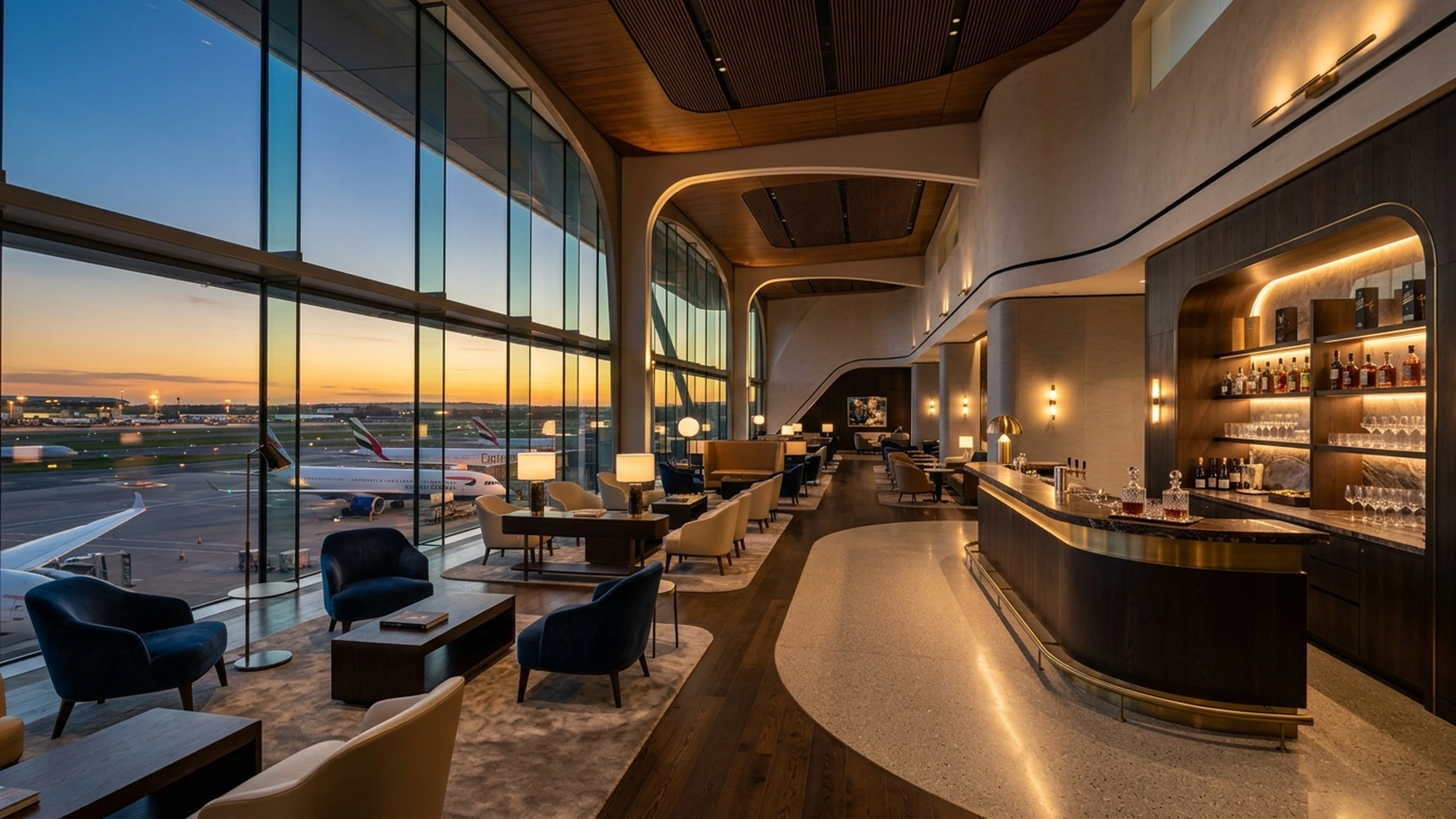
I eat a light dinner at home, something with protein and not much fat, then treat the lounge as a place to hydrate and maybe grab a small snack. If you want the full rundown on which lounges are actually worth your time versus which ones are just marketing, our lounge access guide breaks down the real standouts.
Skip the lounge bar. I know this is the one nobody wants to hear, because free champagne at 6pm feels like the entire point of flying business class. But if you're serious about sleeping on the flight, save the champagne allowance for one glass on board, not pre-gaming in the lounge and then having another glass at 35,000 feet.
Pro Tip
Drink at least 16 oz of water in the two hours before boarding, and skip coffee after early afternoon if your flight departs in the evening. Cabin air will dehydrate you faster than you think, and being even mildly dehydrated makes you groggy AND makes it harder to fall asleep.
Compression socks are non-negotiable for me on anything over six hours. They keep circulation moving in your legs, which reduces the swelling and general achiness that wakes you up at hour four wondering why your ankles feel like water balloons. Grab a pair with actual graduated compression, not the loose airline giveaway socks, which are fine for cabin comfort but do nothing medically.
What should I wear on a business class red-eye?
Loose, layered, and nothing with a waistband that digs in when you recline. I've settled on joggers or soft pants, a t-shirt, and a light zip-up I can take off once the cabin temperature evens out. Business class cabins run around 72°F on average, but that's an average — your feet, specifically, get cold well before the rest of you does, because they're farthest from your core and often not covered by a blanket properly. Keep socks on the entire flight, even under the airline's slipper socks. This one sounds trivial and it is genuinely one of the biggest quality-of-life fixes I've found.
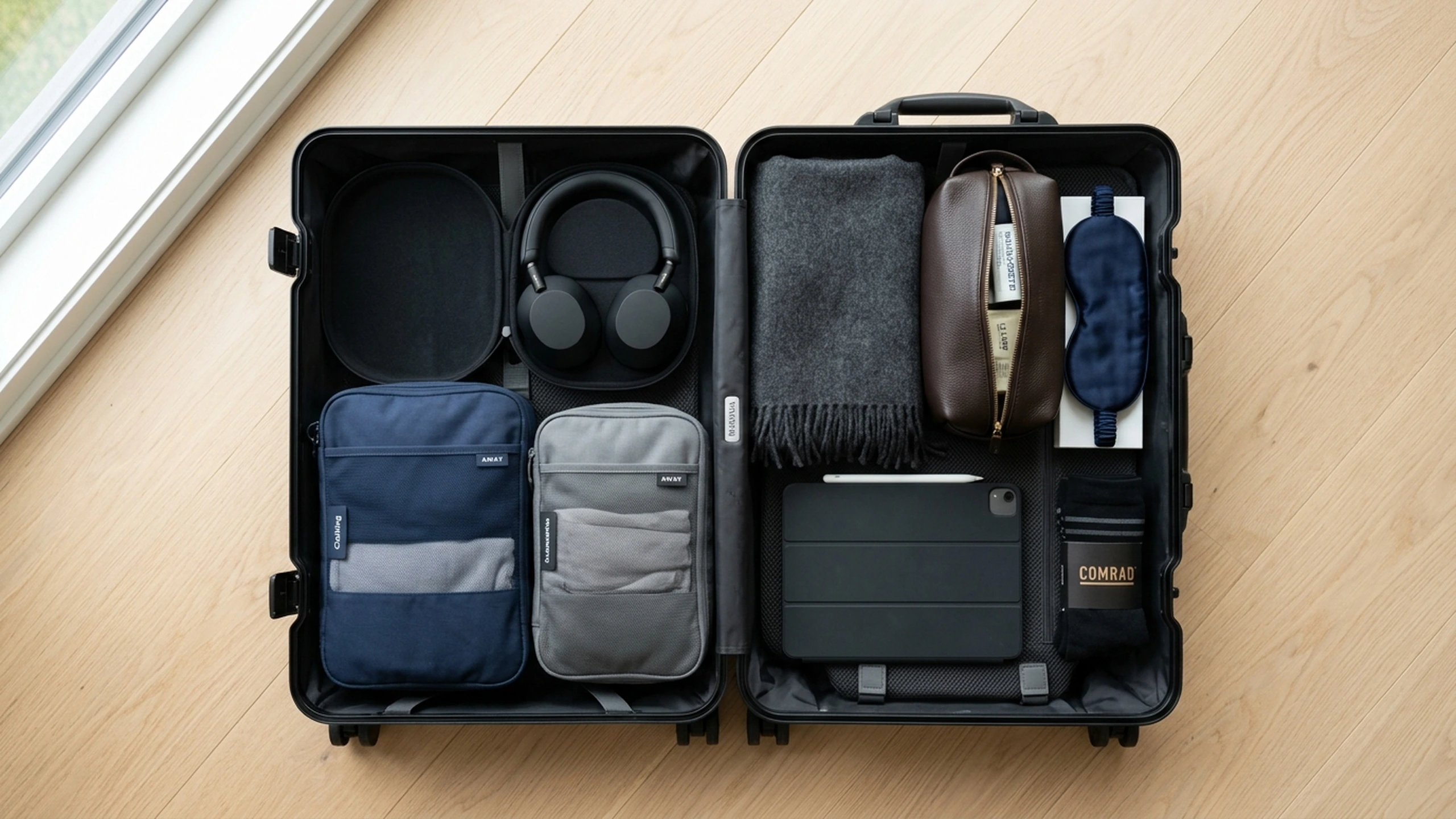
If you haven't sorted your carry-on for this yet, our business class packing guide has the specific items I never fly without, including which eye mask to bring as backup — because airline ones vary wildly, more on that below.
The boarding move almost nobody makes
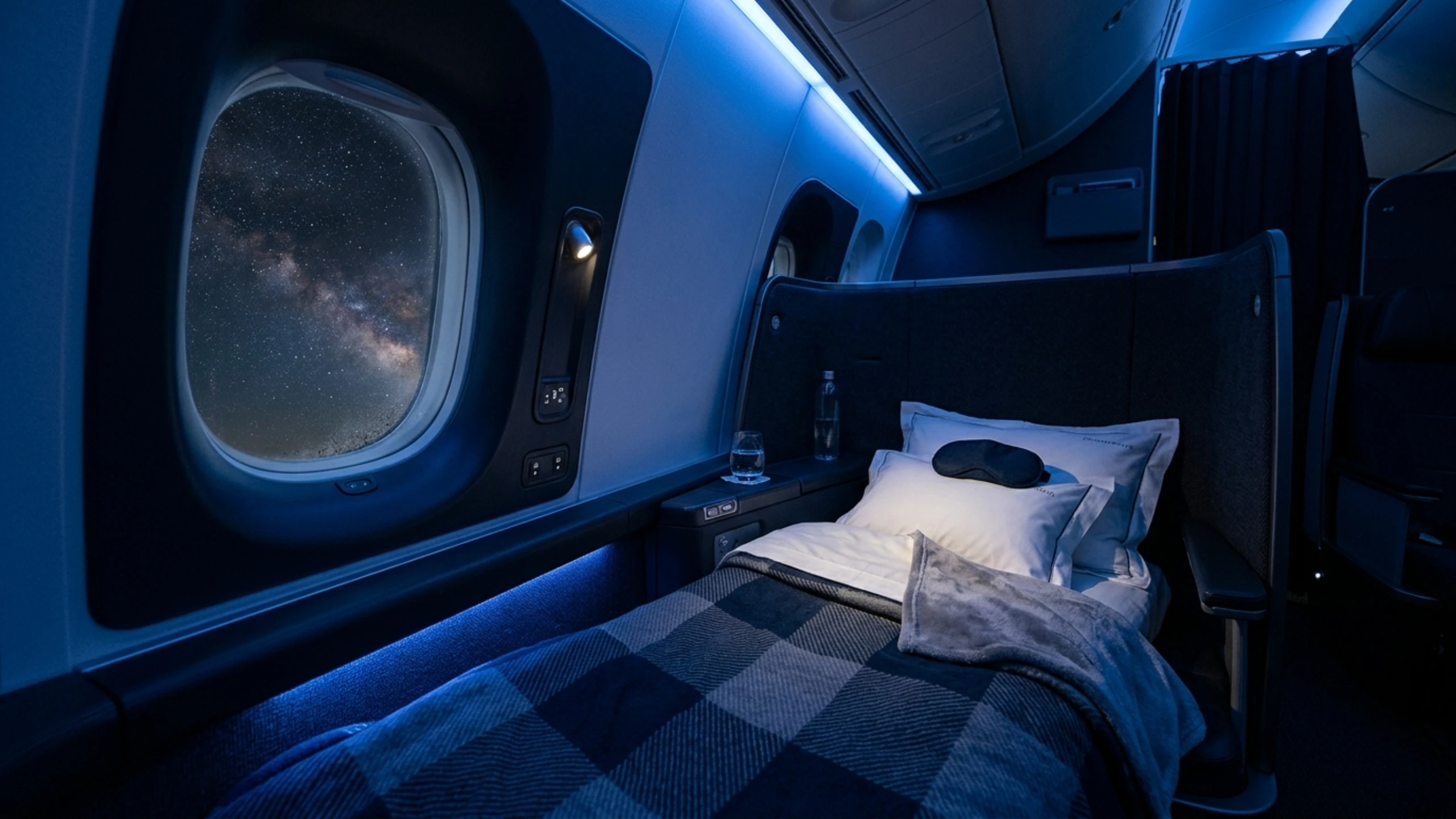
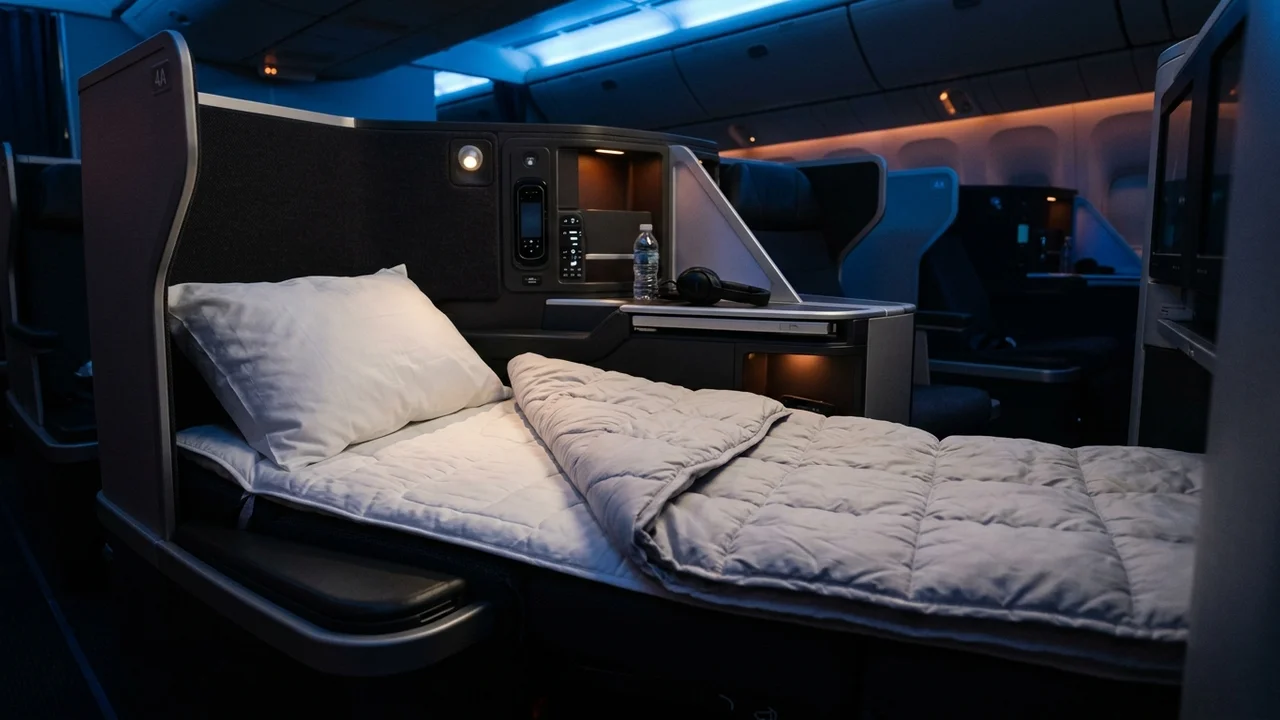
Here's the single highest-leverage thing you can do: as soon as you're seated, ask the flight attendant to set up your bed before meal service, or at least tell them you'd like to skip the full dinner and go straight to sleep after a light bite.
Most crews are used to doing turndown service after the meal, sometimes 90 minutes to 2 hours into the flight. If you're on a true red-eye — say a 10pm or 11pm departure — that's precious sleep time you're losing to a meal service you don't even need. I've started asking gate agents or the crew during boarding: "Can I get the bed made up early tonight, I'm planning to sleep right after takeoff?" On Qatar and Singapore, this request is handled like it's the most normal thing in the world. On some US carriers, you'll get a slightly confused look, but they'll do it.
The early bed request
Ask during boarding, not after takeoff. Crews are setting their service plan before doors close, and it's much easier for them to accommodate a request for early turndown if they know before the meal cart even comes out.
The meal strategy that actually works
This is where most people sabotage their own night. Business class dinner service on a long-haul red-eye can run 90 minutes from amuse-bouche to cheese course, and eating a full three or four course meal right before trying to sleep is basically asking your digestive system to work the night shift while you're trying to shut everything else down.
My rule: eat the appetizer, skip or seriously downsize the main, and stop there. If the appetizer is a good salad or a light soup, great, that's usually enough to take the edge off hunger without loading you up. Skip the bread basket. Skip dessert unless it's fruit.
A few airlines make this easier than others. Qatar Airways and several others offer "Book the Cook," letting you pre-order your meal, including lighter options, before you even board — something I'd recommend doing specifically with an eye toward a smaller, protein-forward dish if you're on a night flight. Emirates and a few others use DO&CO catering, which tends to have decent lighter options on the menu even without pre-ordering, things like a simple grilled fish or a vegetable plate that won't sit like a brick in your stomach.
Pro Tip
If pre-ordering is available on your route, choose the lightest protein option, not the "signature" heavier dish. Save the indulgent meal for your daytime flight home, when sleep isn't the priority.
On the champagne question: have one glass if you want it, with the appetizer, and stop. Not because I'm precious about it, but because a second glass really does measurably hurt your sleep quality at altitude. I've tested this on myself enough times, one glass versus two or three, and the difference in how many times I wake up during the flight is real.
How much melatonin should I take before a red-eye flight?
I'd point you to your own doctor for dosing specifics, since it varies by person, but the timing principle that's worked consistently for me is this: take it about 30 minutes before your actual target sleep time on the flight, not right at boarding. If you take it too early, during boarding or taxi, you'll be groggy through the meal and miss the window, then feel foggy without actually being asleep. I aim for right around when the meal service (or the light version of it) wraps up, then get horizontal shortly after.
Some people prefer a small dose of an over-the-counter antihistamine sleep aid instead, and that's a personal call. What I'd avoid entirely is combining melatonin with a couple of glasses of wine and calling it a sleep strategy — that combination tends to produce a heavier, less restorative sleep with a rougher wake-up.
Noise, light, and the gear that actually matters
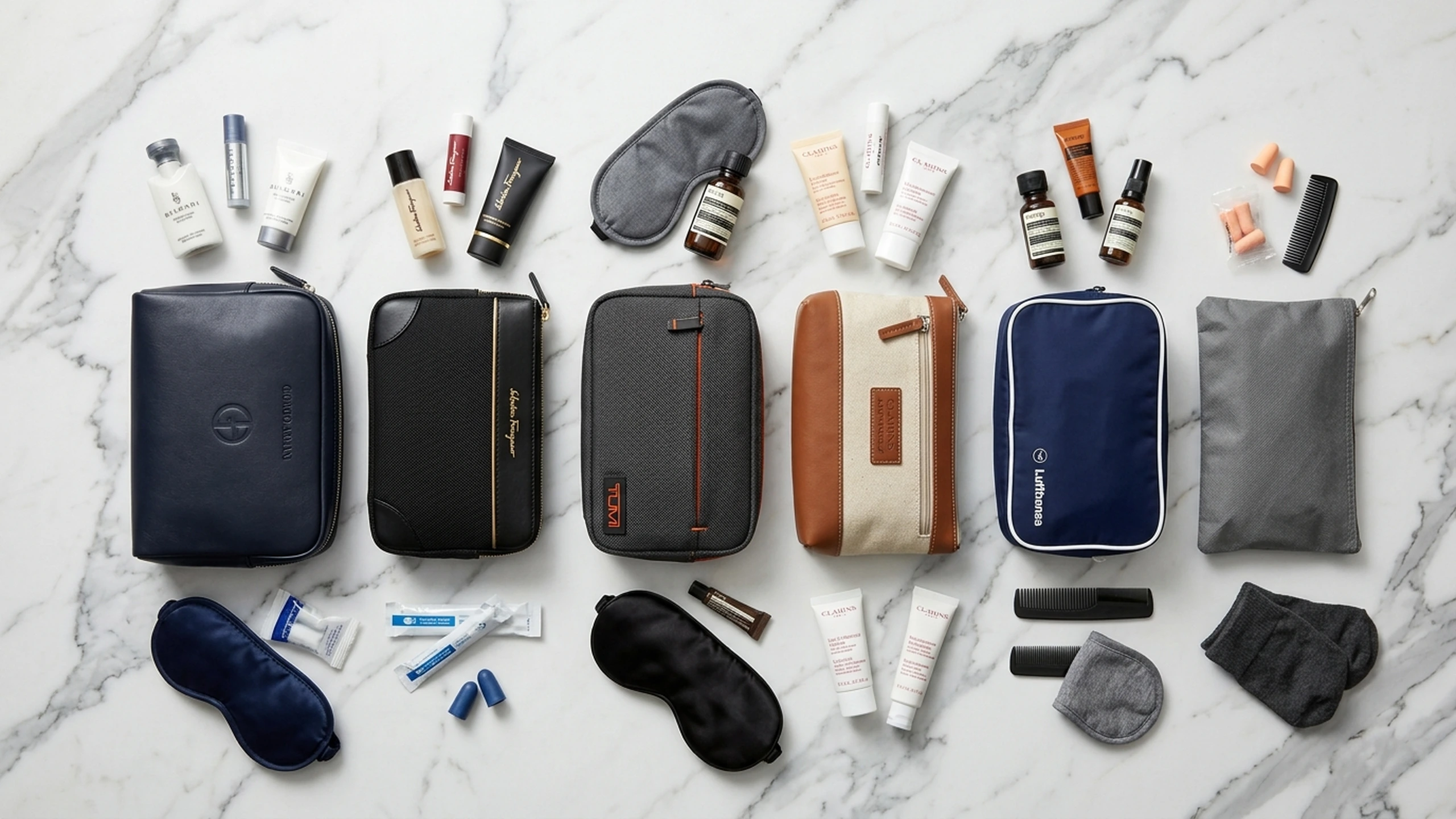
Airline-provided eye masks are wildly inconsistent, and this is one area where I've been genuinely surprised by the gap between carriers. Singapore Airlines' eye mask is one of the better ones I've used — decent padding, actually blocks light, doesn't feel like a paper strip. United's, by contrast, is thin enough that you can basically see the cabin lighting through it, which defeats the purpose entirely.
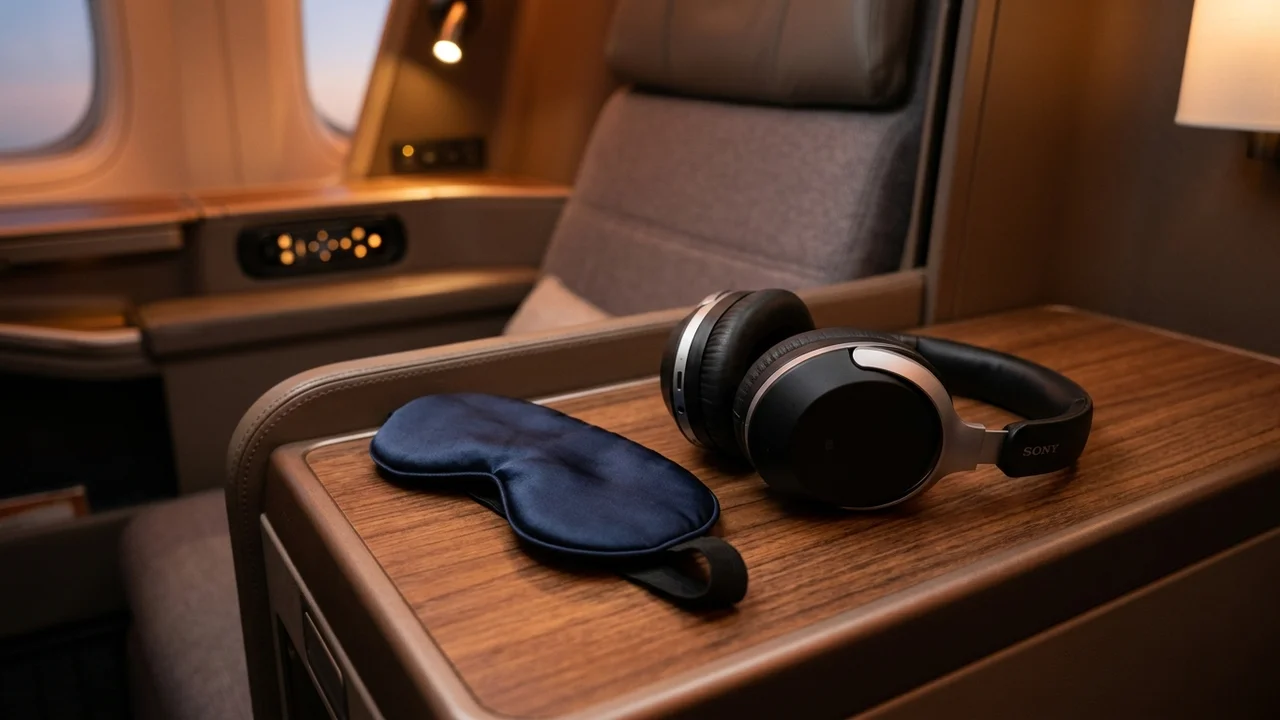
My fix: bring your own. A contoured sleep mask with cushioned eye cups costs $15-25 and outperforms almost every airline amenity kit version I've tried, with the exception of a couple of premium ones. Our amenity kits ranked piece goes through which airlines are actually worth using versus which ones you should swap out immediately.
Noise-cancelling headphones matter more than people expect, even in business class where the cabin is quieter than economy. Engine drone is a low, steady frequency that your brain tunes into over hours, and it's exactly the kind of sound that active noise cancellation handles best. I'd rather have my own over-ear ANC headphones than rely on the airline-provided earbuds, which are fine for watching a movie but not built for sleep — they're rarely comfortable to lie on for six hours, for one thing.
Pro Tip
If you're a side sleeper, skip over-ear headphones once you're actually trying to nod off and switch to comfortable earplugs instead. Over-ear cushions dig in when you're lying on your side against a bulkhead or seat wall.
Ranking the mattress pads, because they matter more than you'd think
Not every airline gives you a mattress pad, and the ones that do vary enormously in thickness and quality. This sounds like a small detail until you're six hours into a flight on a thin foam pad over a hard seat shell, at which point it becomes the only thing you're thinking about.
Here's how I'd rank the ones I've actually flown on, for the actual sleeping surface quality:
- Qatar Airways (Qsuite) — the best I've flown. Thick, genuinely supportive, and paired with good bedding that doesn't feel like a thin duvet cover over cardboard.
- Singapore Airlines — close second. The pad plus their bedding combination is excellent, and the seat-to-bed conversion is one of the flattest, most stable in the business.
- Delta One (Suite) — solidly good. Not quite Qatar or Singapore level, but the Westin-branded bedding and pad are a real step up from most US competitors.
- United (Polaris, with the Saks Fifth Avenue-designed bedding) — surprisingly good, honestly better than I expected the first time I flew it. Not top-tier, but a real improvement over what United used to offer.
- Lufthansa — average. Functional, comfortable enough, but nothing that stands out compared to the others on this list.
Doha (DOH)New York (JFK)
Qatar Airways · Business Class
$3,400
roundtrip
If sleep quality is your top priority when choosing a route, it's worth building your itinerary around the airline first and the price second, at least for the overnight leg. BestBusinessClass.com works with consolidator fares across most of these carriers, so you're not necessarily paying full fare to fly the airline with the better bed.
Which airlines actually deliver the best sleep experience?
If I had to name the airlines that consistently get the whole picture right — seat, bedding, cabin temperature management, crew willingness to do early turndown, and a general understanding that people want to sleep, not be entertained for eight hours — it's a short list: Qatar Airways, Singapore Airlines, ANA, and Delta with its One Suite product.
Qatar's Qsuite has the advantage of a proper door and a design that feels more like a small room than a seat, which matters more for sleep than people realize — even minor ambient light or movement from the aisle can interrupt sleep, and the enclosed suite mostly solves that. Singapore pairs a great physical seat with genuinely excellent, understated service, crew who read the room and let you sleep instead of checking in every 20 minutes. ANA's business class is quieter and calmer than most competitors, with a cabin culture that leans toward letting passengers rest. Delta's One Suite, especially on the A350, has closed better on the seat comfort gap with international carriers than any other US airline.
For a fuller comparison across categories beyond just sleep — food, lounges, loyalty programs — our best business class airlines of 2025 rundown covers where each of these stacks up overall.
A note on seat maps
Even on a great airline, not every seat sleeps the same. Bulkhead seats often have more foot room but less storage; aisle-facing seats in staggered configurations can feel more exposed to cabin traffic and light. If sleep is genuinely the priority, check the seat map details before booking, not just the cabin class.
The part everyone forgets: waking up well
A good sleep strategy falls apart if you handle the landing badly. I set an alarm for 90 minutes before scheduled landing, which gives enough time to actually wake up, not just get startled by the seatbelt sign chime with 20 minutes to go and stumble into an airport looking like you slept in a chair. Because you did.
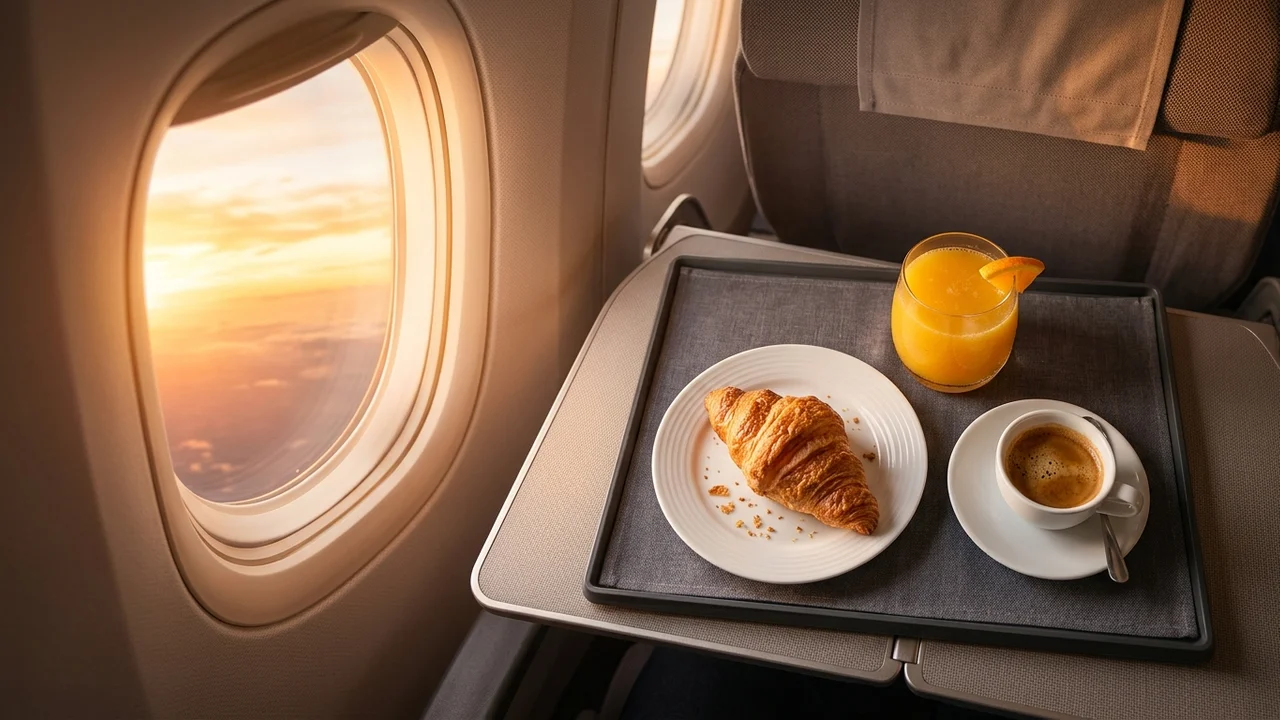
Order an espresso as soon as you're up. Most business class galleys have a real espresso machine, and caffeine timed about an hour to 90 minutes before landing will actually be working by the time you deplane, rather than leaving you jittery and half-asleep during descent. A hot towel, if the crew offers one, does more than you'd expect for actually waking your face and body up — it's a small ritual but it works.
I also try to get some water in before landing, since a full night on dry cabin air means you're likely dehydrated even if you didn't drink alcohol, and dehydration is a big part of why people feel rough getting off overnight flights, even after decent sleep.
Is it better to sleep the whole flight or stay on your destination time zone?
This depends on your trip length and direction, but as a general rule, for red-eyes departing in the evening and landing in the morning at your destination, you want to sleep as much of the flight as possible and wake up close to destination local time. That's the whole point of a red-eye — you're using the flight to do the time-zone adjustment work for you. Fighting it by staying up to watch movies defeats the purpose and usually leaves you both under-slept and jet-lagged.
If your flight doesn't align well with a full night's sleep at your destination's local bedtime, that's a different situation, and staying awake longer or napping strategically might make more sense. But for the classic red-eye — evening departure, morning arrival — sleep early and sleep as much as you can.
Putting it together
None of this is complicated on its own. The problem is that most people do the opposite of all of it by default — heavy lounge meal, two glasses of champagne, full dinner service, movie until 1am, and then wonder why they land feeling wrecked despite paying a premium fare for a flat bed.
The version that actually works is boring by comparison: eat light before the airport, hydrate instead of drinking, ask for early turndown, eat the appetizer and skip the main, time your melatonin, bring your own eye mask, keep your socks on, and wake up with intention instead of getting startled by the seatbelt sign. It's not glamorous advice, but it's the difference between landing functional and landing useless.
If you're planning an upcoming red-eye and want help finding the right fare on one of the airlines that actually gets the sleep experience right, browse current deals or check the specific New York to London route guide for one of the most common overnight routes out there. BestBusinessClass.com works through consolidator fares to get discounted business class pricing on carriers like Qatar, Singapore, and Delta, often well below what you'd find booking directly.
Call (855) 815-4774 for discounted business class fares on the airlines with the best sleep setups
Call NowThis article was created with AI assistance and reviewed by our editorial team.
#tips#sleep#red-eye#overnight-flights#health#business-class#comfort
Enjoy our content? Make us a preferred source on Google.
Business class deals, delivered
Join savvy travelers who receive exclusive deals, route tips, and insider knowledge. Free, weekly, no spam.
Unsubscribe anytime. We respect your inbox.
By submitting, you agree to our Privacy Policy and Terms of Service.
Ready to book your business class flight?
Our specialists access unpublished fares and save you up to 40% on premium cabins.