Airline Reviews12 min readairline-reviewcathay-pacifichong-kong
Cathay Pacific Aria Suite Review 2026: Hong Kong's Answer to the QSuite
Cathay Pacific's new Aria Suite debuted on the airline's A350-1000s in 2025, bringing a 24-inch wide seat with a closing door, wireless charging, and a 4K OLED screen to a 1-2-1 layout.
BC
BestBusinessClass Team
March 9, 2026
Share
Quick summary
Cathay Pacific's new Aria Suite debuted on the airline's A350-1000s in 2025, bringing a 24-inch wide seat with a closing door, wireless charging, and a 4K OLED screen to a 1-2-1 layout. This Cathay Pacific Aria Suite review covers the hard product, the noticeably better dining, and the lounges at Hong Kong International — plus how it stacks up against Qatar's QSuite. Published fares from LAX to Hong Kong run $6,000 to $11,000 round-trip; BestBusinessClass.com has been booking the same seats for $2,800 to $5,200.
I flew the Aria Suite twice this past fall — once LAX-HKG, once HKG-JFK — specifically because I wanted to see if Cathay had actually closed the gap with Qatar Airways, which has owned the "best business class in the sky" conversation for the better part of a decade. Short answer: they've gotten very close. Not identical, and not better in every category, but close enough that the conversation is worth having again.
Cathay Pacific has needed this. The old business class — the one with the herringbone seats and the slightly dated cabin — was fine. Perfectly fine. But "fine" doesn't win headlines when Qatar's QSuite has a literal door and a screen the size of a laptop, and Singapore Airlines is busy reinventing its own product every few years. The Aria Suite is Cathay's answer, and it landed on the A350-1000 fleet in mid-2025 after years of design work and, from what I've heard from crew, more than a few delays.
What the Aria Suite actually feels like in the seat
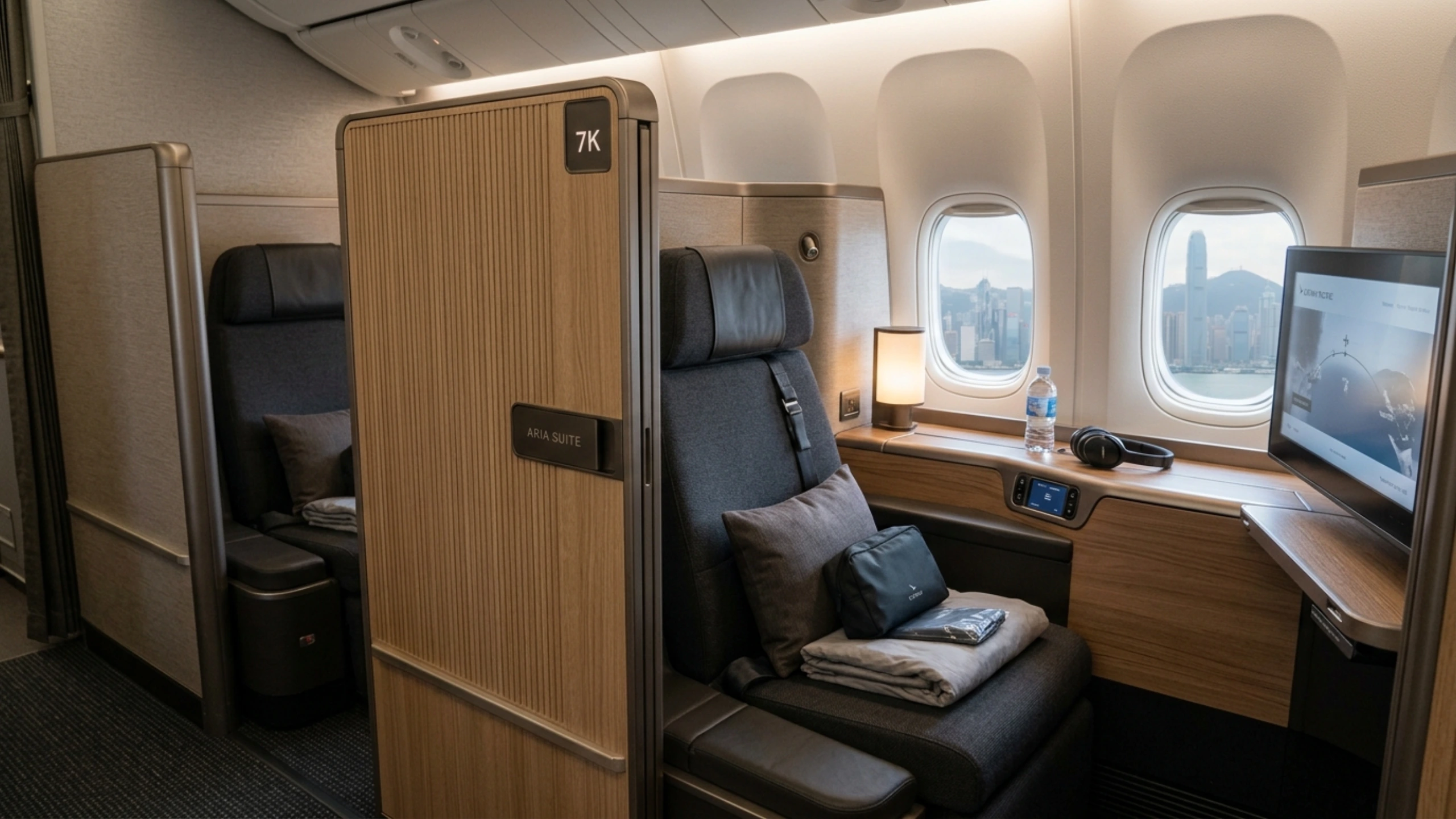
The seat itself is 24 inches wide, which sounds like a spec-sheet number until you're actually in it and realize how much room that gives you to turn sideways, tuck a leg up, or just spread out your stuff without it sliding onto the aisle. The 1-2-1 configuration means every seat has direct aisle access — no climbing over anyone, no awkward middle-seat business class compromise.
The door is the headline feature, and it works. It's not floor-to-ceiling like some first class suites, but it slides shut with a satisfying click and gives you genuine privacy from the aisle. Combined with the high shell walls, you get something close to your own room. I napped through most of the Pacific crossing on the return leg and didn't hear much beyond the occasional cart rolling by.
24 inches
Seat width in the Aria Suite
Storage is where Cathay clearly studied its competitors. There's a proper vanity area with a mirror, a spot for your phone with a wireless charging pad built into the surface (finally — no more cable spaghetti), and enough room for a laptop, a water bottle, and your shoes without playing Tetris every time you need something.
The entertainment screen is a 4K OLED panel, and it's genuinely one of the best I've seen in the sky. Blacks are deep, colors don't wash out even at odd viewing angles, and the touch response is quick — no more jabbing the screen three times hoping it registers. Cathay's content library (Studio+) has improved too, with a decent rotation of recent releases and a strong selection of Cantonese and Mandarin cinema that you won't find on most US carriers.
What makes the Aria Suite different from Cathay's old business class?
The old Cathay business seat — still flying on most of the 777 fleet — is a reverse herringbone with no door, a smaller screen, and noticeably less counter space. It's a good seat by 2015 standards. The Aria Suite fixes essentially every complaint frequent flyers had about it: privacy, storage, screen size, and charging. The one thing that hasn't changed much is legroom, which was already generous, so don't expect a dramatic difference there.
Pro Tip
The Aria Suite is currently only on select A350-1000 routes — Hong Kong to New York, London, and Los Angeles among them. If you book through BestBusinessClass and specifically want this seat, tell your agent — not every Cathay flight on these routes has been retrofitted yet, and some are still running the older 777 product.
The food finally caught up
I'll be honest — Cathay's food has been a mixed bag for years. I've had meals on this airline that were genuinely excellent and meals that tasted like they'd been sitting in a galley oven a beat too long. That inconsistency was probably the single biggest gap between Cathay and its Gulf and Singaporean rivals, who've generally nailed presentation and execution more reliably.
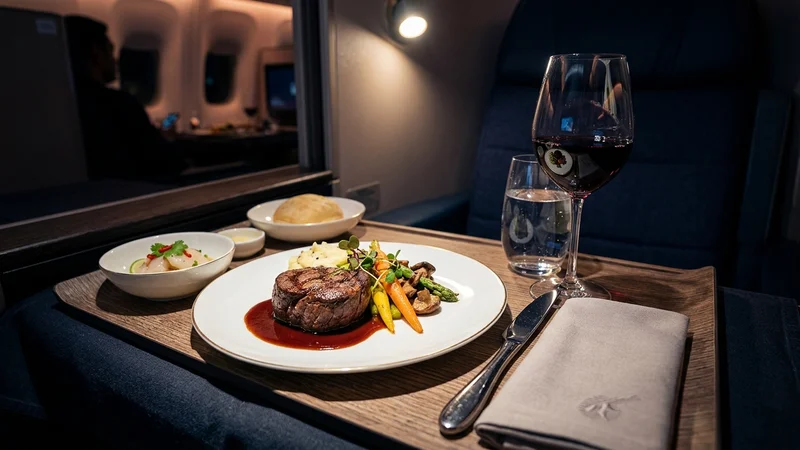
The Aria Suite rollout came with a menu refresh, and it shows. The dim sum course — proper Hong Kong-style siu mai, har gow, and a rotating char siu bao — arrives plated rather than dumped together, and it actually tastes like something you'd order at a decent dim sum spot in Causeway Bay, not reheated catering. That's not a small thing. Dim sum is unforgiving; overcook the dumpling skin by thirty seconds and it turns gummy.
Wine has stepped up too. Cathay pulls from its own cellar program now, and on my LAX flight I had a 2018 Chablis that was better than what I've been poured on several US carriers' first class. The list rotates, so don't expect the exact same bottle every flight, but the quality floor has clearly moved up.
Where it's still inconsistent: the Western mains. My beef short rib on the return flight was good but not memorable, and a colleague on the same route a week later said her fish was overcooked. Cathay still seems to nail the Cantonese and Asian dishes more reliably than the Western options, so if you're flying this route, lean into the noodle soup or the congee rather than the steak.
Honest take
Don't expect miracles from the food just because the cabin looks new. It's better — noticeably better on the Asian dishes — but I've had one so-so main course on each of my two flights. Cathay still has some consistency work to do here, even with the upgraded menu.
Ground game — The Pier and The Wing at HKG
If you're connecting through Hong Kong, the lounges are arguably as big a draw as the seat itself. Cathay operates two flagship business class lounges at HKG, and both are worth arriving early for.
The Wing is the one everyone talks about, and for good reason. It has cabanas — private daybeds with sliding doors and actual daylight coming through floor-to-ceiling windows overlooking the runway. If you've got a long layover, book one of these ahead through the lounge host and take a shower, because the private bathrooms here are genuinely nice, not the cramped airport-shower situation you get most places. The Pier, on the other side of the terminal, is a little more understated but has the better noodle bar of the two, in my opinion. It's a live cooking station where a chef makes wonton noodle soup to order, and it's the kind of thing that ruins airport dining everywhere else for you afterward. I've eaten there on four separate trips and it's never been anything less than genuinely good — a rare case of an airport noodle bar actually living up to its reputation.Pro Tip
If you have a choice between the two lounges and it's your first visit, go to The Pier for the noodle bar, then walk over to The Wing for the cabana and a shower before your flight. Both are accessible on most Cathay business class tickets out of HKG, and it's a fifteen-minute walk between them if you've got the time.
Neither lounge is quite at the scale of Qatar's Al Mourjan in Doha, which is closer to a small luxury hotel than an airport lounge. But the food quality at HKG, especially the noodle bar, is arguably better than anything on offer in Doha.
Is Aria Suite better than Qatar's QSuite?
This is the comparison everyone actually wants answered, so let's get into it.
The hard product is close. QSuite has a bit more configurability — its quad seating for groups traveling together and the double-bed conversion in certain rows are still unmatched by anything Cathay offers. But in a straight 1-2-1 configuration, the Aria Suite's door, screen, and storage are genuinely competitive, and some passengers will prefer the airier, less enclosed feel of the Cathay seat over QSuite's more fortress-like walls.
Where they diverge sharply is philosophy. Qatar's QSuite experience leans into consistency — the food is reliably good across the fleet, the amenity kits are strong, and the whole thing feels engineered for predictability. Cathay's approach, at least right now, is more romantic: it wants you to feel like you're flying somewhere distinctly Hong Kong, from the dim sum to the wine list to the noodle bar in the lounge. When it lands, it's a better experience than QSuite. When it doesn't quite land — an overcooked main, a lounge that's slammed at 6pm — the inconsistency shows more than it does on Qatar.
If I had to pick one for a long-haul flight where I just wanted things to go right every time, I'd still lean Qatar. If I wanted the better overall experience on the ground and in the air when everything clicks, I'd pick Cathay. That's about as close as these two get.
For a deeper look at how Cathay's cabins compare across its fleet, our Cathay Pacific airline page has route-by-route breakdowns of which planes are flying the Aria Suite versus the older product.
How much does Cathay Pacific business class actually cost right now?
Published fares on LAX-HKG in business class are running $6,000 to $11,000 round-trip depending on season, with the higher end showing up around Lunar New Year and summer peak travel dates. That's steep, even by business class standards, and it's part of why so many travelers assume this cabin is out of reach.
BestBusinessClass.com has been booking the same Aria Suite seats on this route for $2,800 to $5,200 round-trip through consolidator fares — discounted tickets sourced through wholesale agreements Cathay and other carriers maintain with agencies like ours. Same seat, same door, same noodle bar. The difference is entirely in how the ticket gets booked, not in what you get once you're onboard.
Los Angeles (LAX)Hong Kong (HKG)
Cathay Pacific · Business Class
$3,400
roundtrip
That's a representative fare we've seen booked recently, not a guarantee — pricing moves with season and availability, and the Aria Suite specifically has limited inventory since it's only flying on a portion of the A350-1000 schedule. If you want a specific route and date, browse current deals or call and ask directly, because these fares don't always sit on the website for long.
Service — still Cathay's strongest asset
Whatever inconsistency exists in the kitchen, it doesn't extend to the cabin crew. Cathay's service has always been a step above the industry average in terms of warmth without being stiff about it, and that held true on both of my Aria Suite flights.
On the LAX departure, my crew member noticed I'd barely touched my meal (jet lag, not the food) and quietly swapped in a bowl of congee later in the flight without me asking twice. Small thing, but it's the kind of attentiveness that's hard to train and easy to notice when it's missing. On the return, the purser did a proper introduction round through business class before takeoff — not scripted, actual conversation.
This is one area where Cathay has always held its own against Qatar and Singapore, and the Aria Suite hasn't changed that. If anything, crew seemed genuinely proud of the new cabin — several mentioned it unprompted, which tells you something about morale after the retrofit.
Is the Aria Suite worth booking over other Cathay cabins?
If you have a choice between the Aria Suite and Cathay's older reverse-herringbone business class on the same route, take the Aria Suite every time — the door and the storage alone are worth the difference. The catch is availability. Right now it's flying primarily on select A350-1000 routes out of Hong Kong, so if your itinerary connects through HKG rather than flying nonstop, you may end up on the older product for one leg.
I'd also say: don't let the marketing push you into assuming every meal will be a highlight. Go in expecting a strong dim sum course, a decent wine pour, and Western mains that are good but not always great. That's an honest baseline, and it's a real improvement over where Cathay was five years ago.
Booking tip
When calling BestBusinessClass to book, ask specifically for A350-1000 routing if you want the Aria Suite — agents can confirm aircraft type at booking, since Cathay doesn't always make it obvious on the fare search itself.
The verdict: 8.5 out of 10
This Cathay Pacific Aria Suite review comes down to a seat that's finally caught up to the category leaders on hard product, paired with a dining and lounge experience that's improved but not yet fully consistent. The door, the screen, the wireless charging pad, and the storage are all genuinely excellent. The Hong Kong lounges — especially the noodle bar at The Pier — are worth the layover on their own.
Where it loses half a point against something like QSuite is consistency: the occasional so-so main course, the fact that Aria Suite isn't yet fleet-wide, and lounges that get crowded during peak evening banks. None of that is a dealbreaker. It's the difference between a 9 and an 8.5, and for most travelers flying transpacific to Hong Kong, that's still one of the better business class experiences available right now.
If you're weighing this against other transpacific options, our New York to London route guide and our Qatar Airways business class review are both worth a look for direct comparisons on pricing and hard product. And if Asia is on your radar more broadly, we've also got route breakdowns for business class to Tokyo that are worth checking against Hong Kong pricing before you commit to a routing.
Call (855) 815-4774 for discounted Cathay Pacific Aria Suite fares
Call NowThis article was created with AI assistance and reviewed by our editorial team.
#airline-review#cathay-pacific#hong-kong#asia#transpacific#a350
Enjoy our content? Make us a preferred source on Google.
Business class deals, delivered
Join savvy travelers who receive exclusive deals, route tips, and insider knowledge. Free, weekly, no spam.
Unsubscribe anytime. We respect your inbox.
By submitting, you agree to our Privacy Policy and Terms of Service.
Ready to book your business class flight?
Our specialists access unpublished fares and save you up to 40% on premium cabins.
Related Routes