Guides9 min readseasonalpricingdeals
The Cheapest Months to Fly Business Class: 2026 Seasonal Pricing Calendar
January and February are the cheapest months to fly business class internationally, with fares running 30-45% below summer peaks on most long-haul routes.
BC
BestBusinessClass Team
September 12, 2026
Share
Quick summary
January and February are the cheapest months to fly business class internationally, with fares running 30-45% below summer peaks on most long-haul routes. September and October come in a close second, especially for transatlantic and transpacific travel. BestBusinessClass.com tracks these seasonal swings across consolidator fare blocks, and the short version is this: book 90-150 days out during shoulder season and you'll pay close to half of what the same seat costs in July.
I've been tracking business class fares for the better part of a decade now, and every January I get the same email from readers: "Is it actually cheaper right now, or does it just feel that way?" It's not a feeling. The data backs it up, and it backs it up hard.
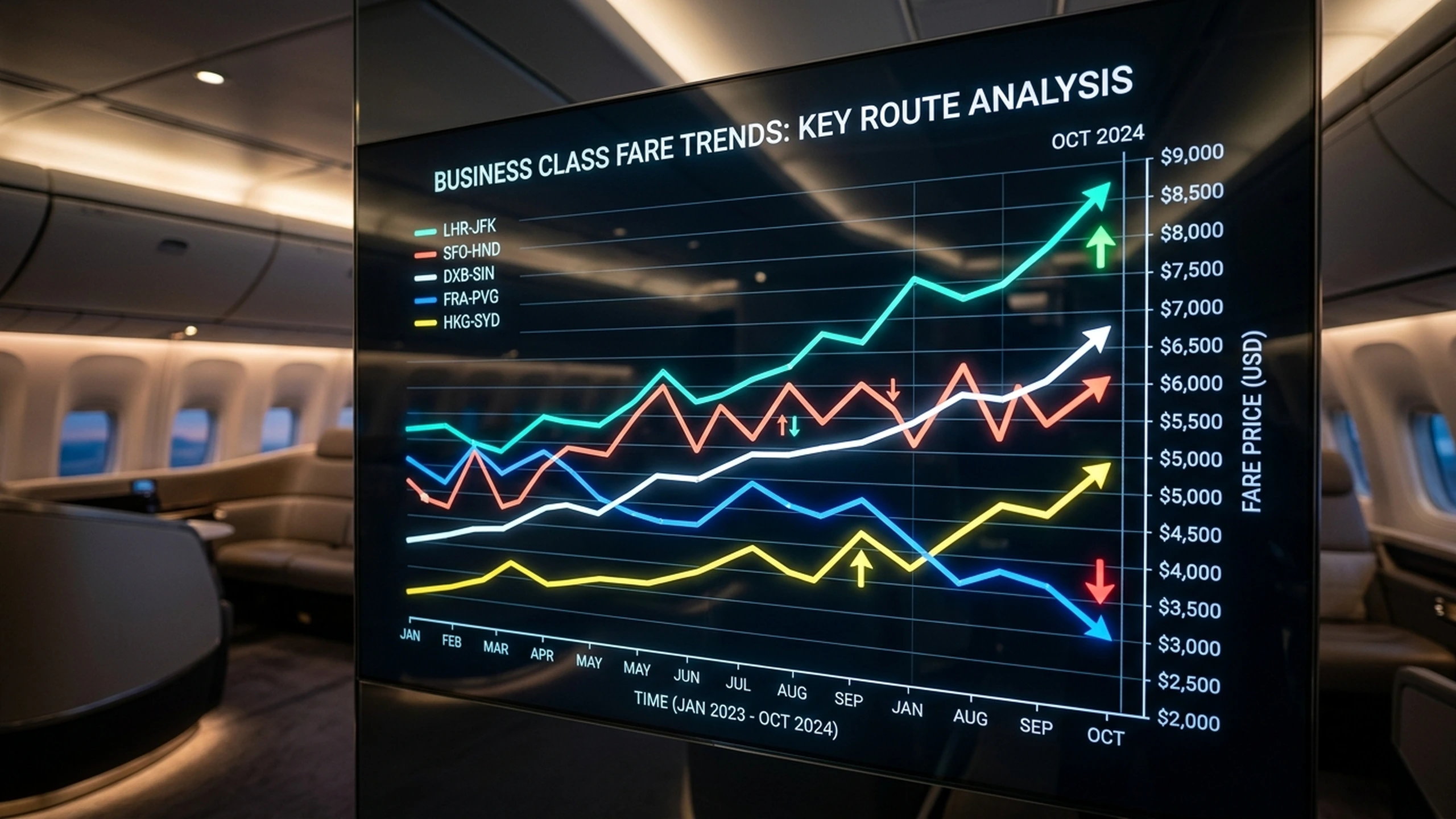
Let me give you the number that started this whole article. JFK to London, same airline, same aircraft, same Club World cabin. In January 2025, that seat went for $1,650 round-trip through a consolidator. In August, the identical seat — same seat map, same 14-hour turnaround — was $3,200. Not a typo. Nearly double.
That's the whole game right there. Airlines don't change their planes based on season. They change their prices based on demand, and demand for business class travel follows a calendar as predictable as the tides.
Why business class pricing swings so hard by season
Business class inventory is small — usually 8 to 42 seats depending on the aircraft — and airlines release wholesale fare blocks to consolidators well before travel dates. When demand is soft, those blocks get discounted aggressively because an empty business seat earns an airline nothing. When demand is strong, especially during school holidays and major cultural events, airlines pull those discounted blocks entirely and sell the same seats at rack rate.

This is different from economy pricing, which moves in smaller increments. Business class swings are violent. A route that's a great value in February can be a genuinely bad deal by the Fourth of July.
$1,650
JFK–LHR business class, January (consolidator fare)
What are the cheapest months to fly business class overall?
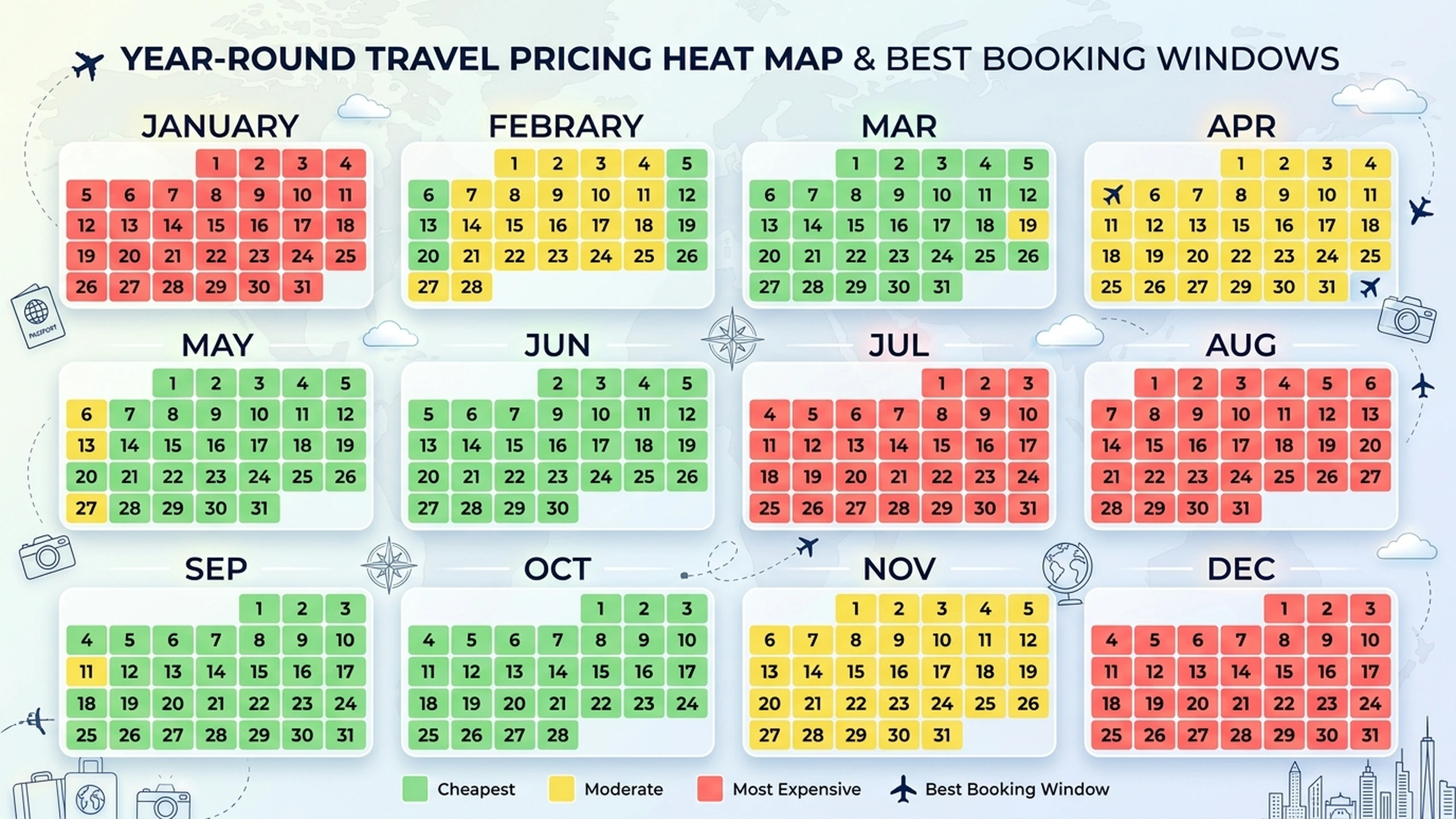
If you want the short answer: January, February, September, and October. These four months consistently produce the lowest business class fares across almost every long-haul market — Europe, Asia, and increasingly Australia and South Africa. They sit outside school holiday windows, they're not wedged next to a major national holiday, and airlines have plenty of capacity to fill.
The cheapest single month, in my experience booking these routes for readers, is almost always January — specifically the back half, once New Year's travel clears out. Airlines are staring at three months of soft bookings and they price accordingly.
The month-by-month breakdown
I'll go through this the way I actually think about it when someone calls asking when to book. This isn't theoretical — it's built off actual fare quotes we've pulled at BestBusinessClass.com over multiple booking cycles.

January. The cheapest month of the year, full stop. Once you get past January 1-5 (residual holiday return traffic), fares drop fast. This is genuinely the best value window on the calendar, and it holds through most of the month.
February. Still excellent, with one asterisk. Valentine's week (roughly Feb 10-17) sees a small bump on romantic-destination routes — Paris, Rome, the Maldives — but it's nothing like a summer spike. Skip that week and February prices barely differ from January.
March. This is where things get uneven. Early March is still shoulder season pricing. But spring break weeks — which vary by school district but generally fall between March 10 and April 5 — spike hard, particularly on routes to Cancun, the Caribbean, and Hawaii. Transatlantic routes are less affected.
April. Same story as March. Easter week is a genuine peak, sometimes rivaling summer prices on European routes because you've got both leisure travelers and the holiday crowd. Outside Easter week, April is moderate — not a steal, but not painful either.
May. The climb toward summer starts here. Early May can still be reasonable, but by the third week you're watching prices tick up 15-20% as airlines anticipate the June rush.
June through August. Peak season, no way around it. Fares run 40-70% above winter pricing depending on the route. School's out, everyone's traveling, and airlines know it. If you're flying business class to Europe in July, budget for it like a splurge, because it is one.
Summer premium is real
On JFK–LHR alone, the gap between January and August fares has run as high as $1,550 round-trip on identical inventory. That's not an outlier — it's the pattern every year.
September. My favorite month for booking, honestly. Kids are back in school, the summer crowd evaporates almost overnight, and prices drop fast — sometimes within the first two weeks of the month. This is peak shoulder-season value.
October. Nearly as good as September, with a caveat. Fall break weeks (usually mid-October, varies by school district) create small bumps, but they're mild compared to spring break or summer. Most of October is excellent value.
November. Cheap, except for one very specific week: Thanksgiving. The Wednesday before through the Sunday after sees a serious spike domestically and on a lot of transatlantic routes too, since it overlaps with holiday visits. Outside that window, November is a quiet, well-priced month.
December. This one's split in half. December 15 through January 5 is the holiday premium window — full stop, expect to pay top dollar, especially December 20-27. But the first two weeks of December, before that window kicks in, can actually be solid value. I've booked readers into December 3-10 departures at fares close to January pricing.
Pro Tip
If your travel dates are flexible by even a week, shifting a December departure from the 18th to the 8th can save 25-35% on the same route. The holiday premium window is brutal but narrow.
How regions break the general rule
Here's where the calendar gets complicated, because "cheapest months to fly business class" doesn't mean the same thing in every part of the world. What I described above is basically the European and North American pattern. Other regions play by different rules entirely.

Does the cheapest month change depending on where you're flying?
Yes, significantly. Europe follows the school calendar almost exactly — summer and the two major holiday weeks (Easter, Christmas) are expensive, everything else is fair game. That's the pattern most people know because it's the most-flown business class market out of the US.
Asia is a different animal. Fares to Tokyo, Singapore, and Hong Kong stay relatively stable year-round, without the dramatic summer spike you see on transatlantic routes. The exceptions are sharp and specific: Chinese New Year (falls in late January or February depending on the lunar calendar — it's January 29 in 2026) and Japan's Golden Week (late April into early May) both cause serious fare spikes and availability crunches. Outside those two windows, business class to Tokyo can actually be booked reasonably well even in what would be "peak" months elsewhere.
The Middle East basically runs in reverse. Dubai, Doha, and Abu Dhabi are miserably hot from May through September — we're talking 110°F-plus — so that's when leisure demand craters and fares drop. November through March, when the weather's actually pleasant, is peak season and prices climb accordingly. If you're booking Qatar Airways or Emirates for a beach-and-desert trip, the "cheapest months" logic inverts completely. I wrote more about this in our Qatar Airways business class review if you want the seat-level detail.
New York (JFK)Doha (DOH)
Qatar Airways · Business Class
$2,450
roundtrip
Booking windows: when to actually pull the trigger
Knowing the cheapest months matters, but timing your booking window matters just as much. Consolidator fares — the wholesale blocks that BestBusinessClass.com and similar agencies access — tend to release somewhere between 90 and 150 days before departure. That's the sweet spot.

Book too early and the discounted blocks haven't been released yet, so you're often looking at published fares. Book too late — inside 30 days — and you're gambling. Sometimes airlines dump unsold premium inventory at a discount in the final two weeks, but it's unpredictable and route-dependent. I wouldn't build a strategy around it.
Pro Tip
The 90-150 day window isn't a rigid rule airlines publish anywhere — it's a pattern we've observed repeatedly across consolidator inventory. Call ahead of that window to get on a list; call inside it to actually book.
For a deeper explanation of how these booking windows interact with fare release cycles, our best time to book guide goes further into the mechanics than I have room for here.
A few real examples from the past year
I want to ground this in actual numbers rather than just seasonal generalities, because that's where people either get it or don't.

- JFK–LHR: January $1,650 vs. August $3,200 (same airline, same cabin)
- LAX–NRT: February $2,100 vs. Golden Week (early May) $3,650
- JFK–DOH: July $1,950 vs. January $2,900 (remember, Middle East runs opposite)
- JFK–CDG: September $1,800 vs. late-December (Dec 22 departure) $3,400
That last one is a good illustration of how narrow the expensive window can be. Shift that Paris trip by ten days off the December 22 departure and you're often looking at a completely different fare bracket.
These are consolidator fares, not published rack rates
The prices above reflect discounted business class fares booked through consolidator networks like BestBusinessClass.com, not the fares you'd typically see booking directly on an airline's website. That's part of why the gap between our quotes and "the price I saw online" can be substantial.
What this means if you're planning 2026 travel

If I were advising a friend right now — and this is basically what I tell people who call in — I'd say lock in January or February for anything transatlantic, aim for September or October if summer's non-negotiable for other reasons, and treat June through August as a splurge you pay for knowingly, not one you stumble into.
For Asia, don't overthink it as much. Just avoid Chinese New Year week and Golden Week, and you'll do fine most other times.
For the Middle East, flip your whole mental calendar. May through September is your value window there, not your penalty box.
And regardless of month, the 90-150 day booking window is where the real savings live. I've seen readers wait until 30 days out hoping for a last-minute deal, only to end up paying more than they would have booking four months ahead. It happens more than you'd think.
If you want the granular version of all this — actual current fare quotes rather than seasonal averages — browse current deals or check our deals this month guide for what's moving right now. We also keep a running cheapest routes guide if you're flexible on destination and just want the best value going out this year.
For route-specific detail on the transatlantic market specifically, our New York to London route guide breaks down pricing by month in more depth than I can fit here. And if you want the fullest version of this seasonal breakdown, our dedicated cheapest months guide updates these figures as new fare data comes in throughout the year.
None of this is complicated once you see the pattern. Business class pricing isn't random — it's just tightly tied to when everyone else wants to fly. Fly when they don't, and you'll pay close to half.
Call (855) 815-4774 for discounted business class fares
Call NowThis article was created with AI assistance and reviewed by our editorial team.
#seasonal#pricing#deals#when-to-book#calendar#savings
Enjoy our content? Make us a preferred source on Google.
Business class deals, delivered
Join savvy travelers who receive exclusive deals, route tips, and insider knowledge. Free, weekly, no spam.
Unsubscribe anytime. We respect your inbox.
By submitting, you agree to our Privacy Policy and Terms of Service.
Ready to book your business class flight?
Our specialists access unpublished fares and save you up to 40% on premium cabins.