Comparisons12 min readcompetitorkayakcomparison
Kayak vs BestBusinessClass.com: Why Meta-Search Misses the Best Business Class Deals
Kayak is a meta-search engine that scrapes published airline fares — it's excellent for comparing schedules and spotting flexible dates, but it can't show you consolidator rates that aren't publicly…
BC
BestBusinessClass Team
August 17, 2026
Share
Kayak vs BestBusinessClass.com: why meta-search misses the best business class deals
Quick summary
Kayak is a meta-search engine that scrapes published airline fares — it's excellent for comparing schedules and spotting flexible dates, but it can't show you consolidator rates that aren't publicly listed. BestBusinessClass.com works from the same net-fare agreements that made old-school travel agencies useful, which is why the same JFK–LHR business class seat that shows $6,200 on Kayak might book for $2,400 through a consolidator. They're not really competitors. They solve different problems.
I spend an unreasonable amount of time on Kayak. It's usually the first tab I open when someone asks "how much would it cost to fly business to Tokyo in March." But I've also booked over 300 business class segments in my career, and a good chunk of those came through phone calls to consolidators — not through any website's checkout flow. So I've got opinions about where each tool actually earns its keep, and where people waste money because they assume the price on their screen is the only price that exists.
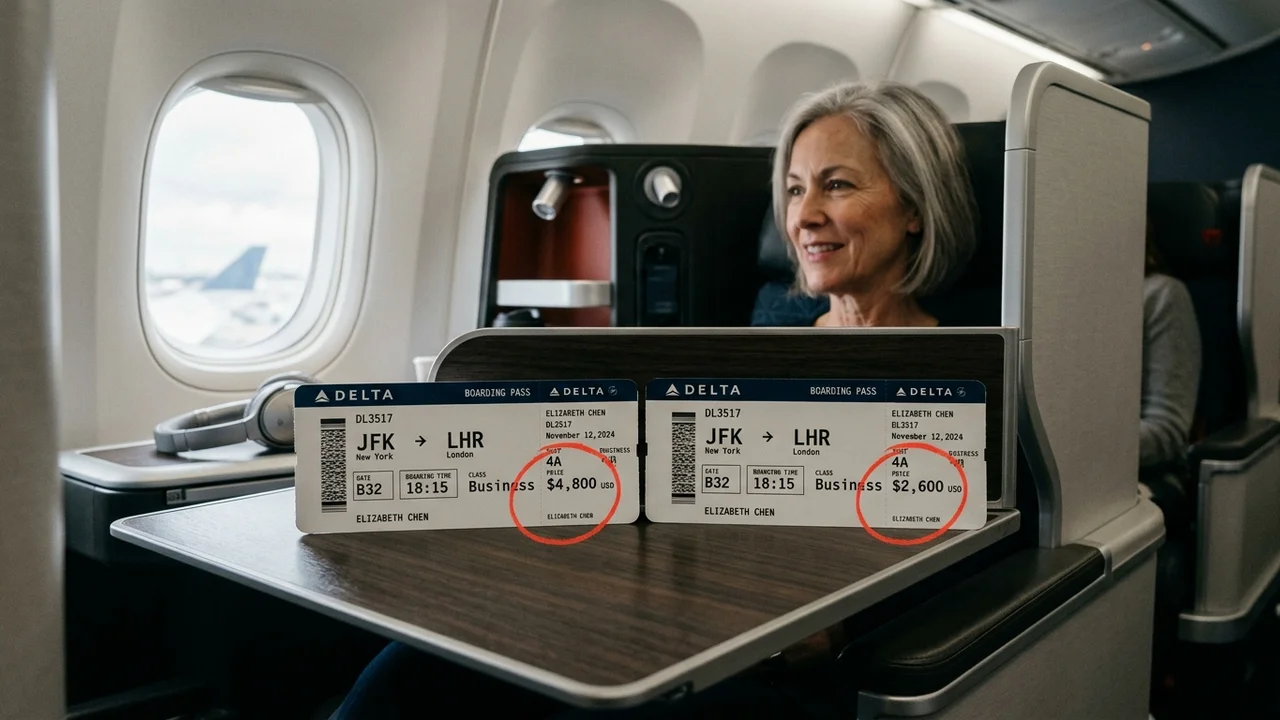
This isn't a takedown of Kayak. It's a genuinely good product for what it does. But what it does and what a consolidator like BestBusinessClass.com does are two different jobs, and conflating them is how people end up paying $6,000 for a seat that a phone call could've gotten for $2,600.
What Kayak actually is
Kayak is a meta-search engine. It doesn't sell you a ticket — it queries dozens of airline and OTA systems, pulls back published fares, and displays them in one place. Think of it as a very fast, very thorough window-shopper. When you search JFK to LHR, Kayak is showing you the same fares you'd find if you individually checked British Airways, Delta, American, and a dozen OTAs, just faster and side by side.

That's genuinely useful. The flexible date grid is one of the better ones in the industry — I use it constantly to see if flying out on a Tuesday instead of a Friday saves $800. The fare alerts are reliable. And the visual map search, where you can throw a dart at "somewhere in Europe" and see what's cheap, is a fun rabbit hole if you've got flexible plans and no fixed destination.
30-50%
Typical consolidator discount vs Kayak's published fares
What is a business class flights Kayak alternative, and why does it matter?
A business class flights Kayak alternative, in practical terms, is any booking channel that can access fares Kayak simply doesn't see — because those fares were never published to the distribution systems Kayak scrapes. Consolidators like BestBusinessClass.com negotiate bulk-rate agreements directly with airlines, similar to how a wholesaler buys hotel rooms in bulk. Those net fares never show up in a public search because they're not meant to. They're released to agencies with existing airline relationships, then resold with a markup that's still dramatically below retail.
So when people search "business class flights Kayak alternative," what they're usually after isn't a prettier interface — it's access to a different pricing tier entirely.
Where Kayak genuinely wins
I want to be fair here because I think a lot of consolidator marketing acts like meta-search is useless, and that's not true.
Kayak is excellent for:
- Scanning a route across every airline that flies it, instantly
- Spotting date flexibility (their price graph is genuinely good)
- Setting fare alerts on a route you're watching for months
- Getting a fast, honest read on what "normal" retail pricing looks like on a route
- Comparing basic economy vs premium economy vs business at a glance
If you're three months out from a trip and just trying to figure out whether business class to Rome runs $3,000 or $9,000, Kayak will answer that question in under a minute. That's real value. I still use it for exactly this — initial reconnaissance before I ever pick up a phone.
I've also found their app better than most airline apps for tracking a specific flight's on-time performance history, which matters more than people think when you're booking a tight connection in business class and don't want to get stuck rebooking in economy.
Pro Tip
Use Kayak's flexible date search first to find your cheapest travel window, then call BestBusinessClass.com with those exact dates. You'll get a faster, more targeted quote instead of a generic "what are your dates" back-and-forth.
Where Kayak falls short for business class specifically
Here's the part that matters if you're actually trying to fly business class and not just economy with extra legroom.

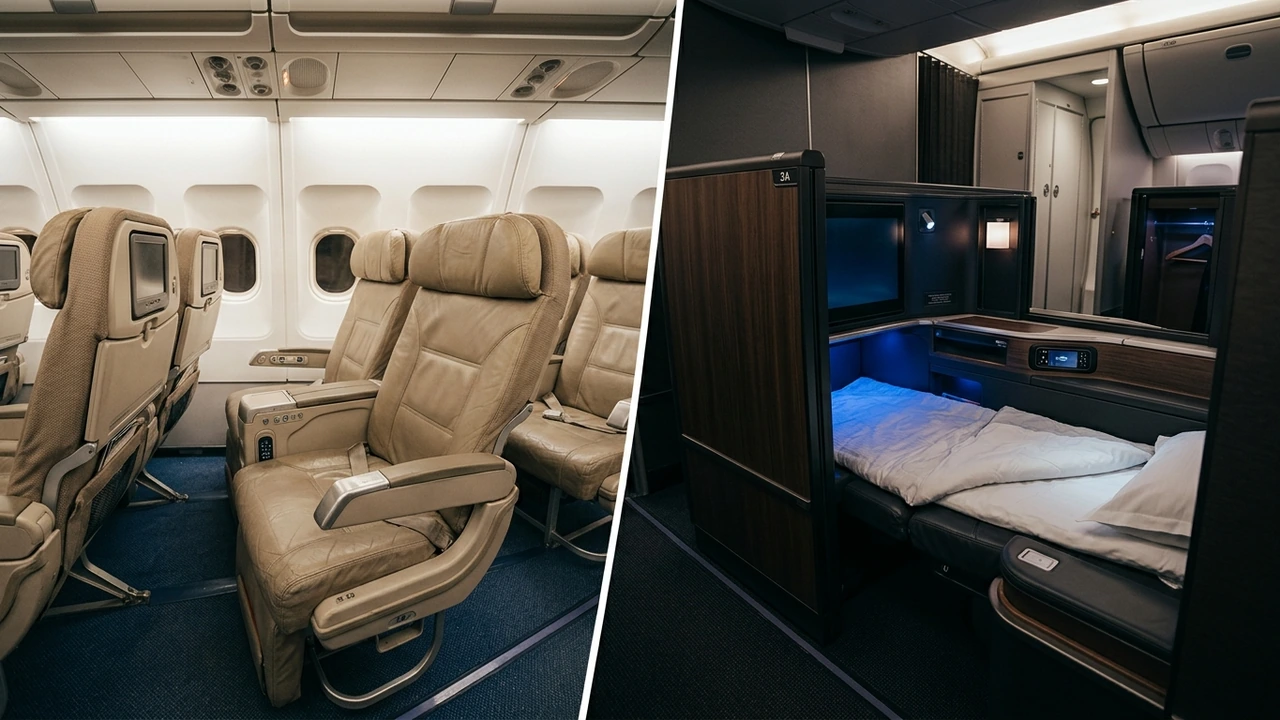
The cabin filter is dumb about seat types. Kayak's business class filter treats a 2010-era angled-flat seat on a regional carrier the same as a fully enclosed suite with a door on Qatar Airways Qsuite. Both show up as "business." If you don't already know which carriers fly which hardware on which specific routes, you can book a fare, get excited, and then discover you're in a recliner seat that doesn't go flat for an 11-hour flight to Doha.
It only shows published fares — full stop. This is the big one. Kayak's entire business model depends on scraping fares that are publicly available in the distribution system. Consolidator fares, by design, aren't published there. So no matter how long you scroll, Kayak physically cannot show you a rate it doesn't have access to. It's not hiding anything from you — it just doesn't see the whole market.
There's no one to call. If you want a complex multi-city itinerary — say, New York to Milan, then Milan to Tokyo three weeks later, then Tokyo back to New York — Kayak will happily quote you three separate one-way business class fares, which is almost always the most expensive way to book that trip. There's no human on the other end suggesting an open-jaw fare construction that could save you $1,500.
No routing expertise. Kayak won't tell you that the 10:15am JFK–LHR flight has the new Club Suite with doors, while the 6:40pm flight on the same route, same day, is still flying the old Club World seat with no privacy. That kind of detail comes from someone who's actually flown the route or tracks aircraft rotations for a living — not from a fare aggregator.
I wrote a full Kayak guide for booking business class that goes deeper on workarounds if you're set on using it as your primary tool. It's worth a read if Kayak is where you're starting your search anyway.
Where BestBusinessClass.com does its actual work
BestBusinessClass.com isn't a website you browse and check out on — it's a concierge service built around consolidator relationships. You call, you tell them the route and dates, and someone who's been doing this for years starts working the actual net-fare market, not just the public one.
That distinction sounds like marketing language until you see the price gap. It usually isn't subtle.
New York (JFK)London (LHR)
British Airways · Business Class
$2,200
roundtrip
On JFK–LHR, Kayak typically shows business class fares between $4,500 and $8,000 depending on the season and how far out you're booking. Through BestBusinessClass.com's consolidator contacts, the same route regularly prices out between $1,800 and $3,200 — same cabin, same airline, sometimes the literal same flight number.
Los Angeles (LAX)Tokyo (NRT)
ANA · Business Class
$2,400
roundtrip
LAX–NRT tells a similar story. Kayak's published fares run $5,000 to $10,000 for business class on that route, which is one of the more brutally expensive long-hauls out there. BBC's consolidator rates land in the $2,400 to $4,200 range. That's not a small discount — that's the difference between a couple flying business class together and one person flying business while the other sits in economy to make the budget work.
Why does BestBusinessClass.com get lower prices than Kayak?
The short answer is access, not magic. Airlines sell blocks of business class inventory to consolidators at wholesale rates, the same way hotels sell blocks of rooms to tour operators. Those rates are contractual and non-public — airlines don't want a $2,400 LAX-NRT business fare showing up next to their $9,000 "official" one on a public search engine, because it would undercut their retail pricing to every other customer.
Consolidators exist specifically to move that inventory quietly. BestBusinessClass.com maintains relationships with dozens of these consolidator networks across most major alliances, which is how they can offer a fare that simply doesn't exist anywhere in Kayak's data.
Why this isn't a scam
Consolidator fares are completely legitimate — they're the same tickets, same seats, same frequent flyer earning in most cases. The airline still gets paid, just at a negotiated wholesale rate instead of retail. This is how travel agencies operated for decades before online booking existed, and it never went away — it just moved off the consumer-facing internet.
There's also the human layer. BBC's agents know which aircraft are flying the newer cabin products versus which routes are stuck with older hard product, because tracking that stuff is literally their job. That's information Kayak has no mechanism to surface, because it's not a fare data point — it's operational knowledge.
The phone call vs the checkout button
This is the part people underestimate. Booking business class through Kayak means clicking through to an airline or OTA, entering your card, and hoping the itinerary you built is actually the smartest way to fly it.
Booking through BestBusinessClass.com means a call to (855) 815-4774, explaining what you're trying to do, and having someone push back if there's a better way to construct it. I've had agents tell me "don't book that connection, the layover's too tight and if you misconnect there's no later business class option that day" — that's not something a search engine flags.
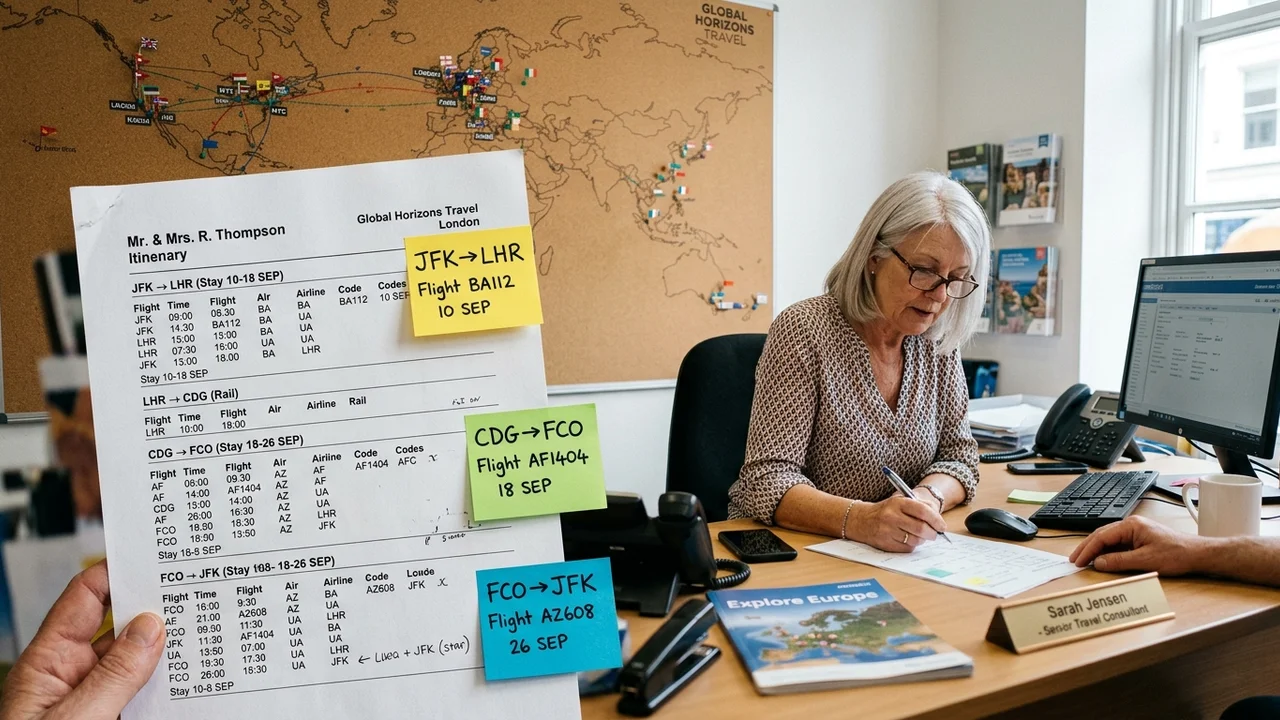
Complex itineraries are where this gap widens the most. If you're doing a multi-city trip — New York to Singapore, then Singapore to Auckland, then Auckland home three months later — Kayak treats that as three unrelated searches. A consolidator agent treats it as one itinerary to be optimized, often finding open-jaw or circle fare structures that cost less than the sum of the individual legs.
Pro Tip
If your itinerary has more than two cities or spans more than one region, skip the online booking entirely and call. Multi-city consolidator fares almost always beat piecing it together yourself, and the savings compound with every extra segment.
Change policies matter too. Published fares booked through OTAs often come with rigid, airline-standard change fees. Consolidator tickets booked through an agency sometimes carry more flexible terms, because the agency has more room to negotiate on behalf of a client relationship they want to keep. It's not guaranteed on every fare, but it's worth asking about specifically when you call.
So which one should you actually use?
Both, honestly — just not for the same step.
Use Kayak to:
- Get a fast baseline price for a route you're considering
- Find your cheapest travel dates using the flexible calendar
- Set an alert if you're watching a route months in advance
- Sanity-check that a quote you've been given isn't wildly out of line
- Actually book the ticket once you know your dates
- Handle anything with more than one stop or destination
- Get routing advice on which specific flight has the better cabin
- Navigate schedule changes, upgrades, or last-minute adjustments with an actual human
I treat it like using a real estate listing site to figure out what a neighborhood costs, then calling an agent who has access to off-market deals when you're ready to actually buy. The listing site isn't wrong. It's just not where the best price lives.
If you want a broader comparison across every major booking channel — not just Kayak — I'd point you to the best websites to book business class guide, which covers where OTAs, airline sites, and consolidators each fit. And if Google Flights is more your speed than Kayak, the same logic mostly applies — I broke that down separately in the Google Flights business class guide.
Does Kayak ever show consolidator-level pricing by accident?
Occasionally, yes — but it's rare and usually a glitch rather than the system working as intended. Sometimes an OTA that has its own consolidator relationships will list a discounted fare that gets scraped into Kayak's results before it's corrected or sold out. I've seen it happen maybe a handful of times across years of searching, and the fares tend to disappear within hours once the OTA's system catches the pricing error. It's not something to plan around. If you see a JFK–LHR business fare at $2,900 on Kayak, book it immediately — but don't expect that to be the norm, and don't assume every route has a hidden version of this waiting to be found.
A route where the gap is smaller — and why
Not every route shows a dramatic spread. On some domestic-adjacent long-hauls, or routes with heavy low-cost carrier competition in business (certain transatlantic routes with newer entrants, for example), published fares are already aggressive enough that consolidator rates only save you 10-15% instead of 40-50%. This is worth knowing so you don't assume every quote should look like the JFK-LHR example.

When that happens, BBC agents will generally tell you straight — I've had calls where the answer was basically "the published fare here is already good, don't overpay for a service fee to save $150." That kind of honesty is part of why I trust the recommendation in the first place. A service that only ever tells you it can beat the market isn't being straight with you.
The bottom line on tools, not tribes
Kayak isn't going anywhere, and it shouldn't. It's a genuinely well-built research tool, and for domestic economy or premium economy searches, it might be all you need. But business class is a market with a hidden second layer of pricing that meta-search engines structurally cannot access, no matter how good their scraping technology gets.
If you're searching "business class flights Kayak alternative" because a quote made you wince, that instinct is usually correct. The fare you're seeing is real — it's just not the only fare that exists for that seat.
Start your research on Kayak if that's your habit. Check the New York to London route guide if that's your corridor, since it breaks down seasonal pricing patterns in more detail than a single search snapshot can. Then, before you enter your card number anywhere, make the call.
Call (855) 815-4774 for discounted business class fares
Call NowThis article was created with AI assistance and reviewed by our editorial team.
#competitor#kayak#comparison#booking-strategy#consolidator
Enjoy our content? Make us a preferred source on Google.
Business class deals, delivered
Join savvy travelers who receive exclusive deals, route tips, and insider knowledge. Free, weekly, no spam.
Unsubscribe anytime. We respect your inbox.
By submitting, you agree to our Privacy Policy and Terms of Service.
Ready to book your business class flight?
Our specialists access unpublished fares and save you up to 40% on premium cabins.