Travel Tips10 min readglossarylie-flatseat-types
Lie-Flat Seats Explained: Every Configuration, Airline & What to Expect (2026)
Not all lie-flat seats are the same bed.
BC
BestBusinessClass Team
July 23, 2026
Share
Quick summary
Not all lie-flat seats are the same bed. Some give you 82 inches to stretch out with a door you can close; others cram you into a 73-inch pod at a diagonal angle you'll feel in your lower back over the Atlantic. This guide breaks down every major configuration flying in 2026 — reverse herringbone, staggered, 1-2-1, the dying 2-2-2 — so you know what you're actually booking before you hand over $4,000. BestBusinessClass.com books these fares every day and can tell you exactly which plane and which seat to pick.
I've flown enough business class rows to know that "lie-flat" on a fare search means almost nothing. It's a marketing word airlines slap on everything from a genuinely flat 82-inch bed with a sliding door to a seat that reclines to 165 degrees and leaves your feet wedged under the console in front of you.
Both get called "lie-flat." Only one of them is worth the money.
So let's get into what these seats actually are, how the configurations differ, and how to check before you book instead of finding out at 35,000 feet that your "flat bed" isn't actually flat.
What does lie-flat actually mean?
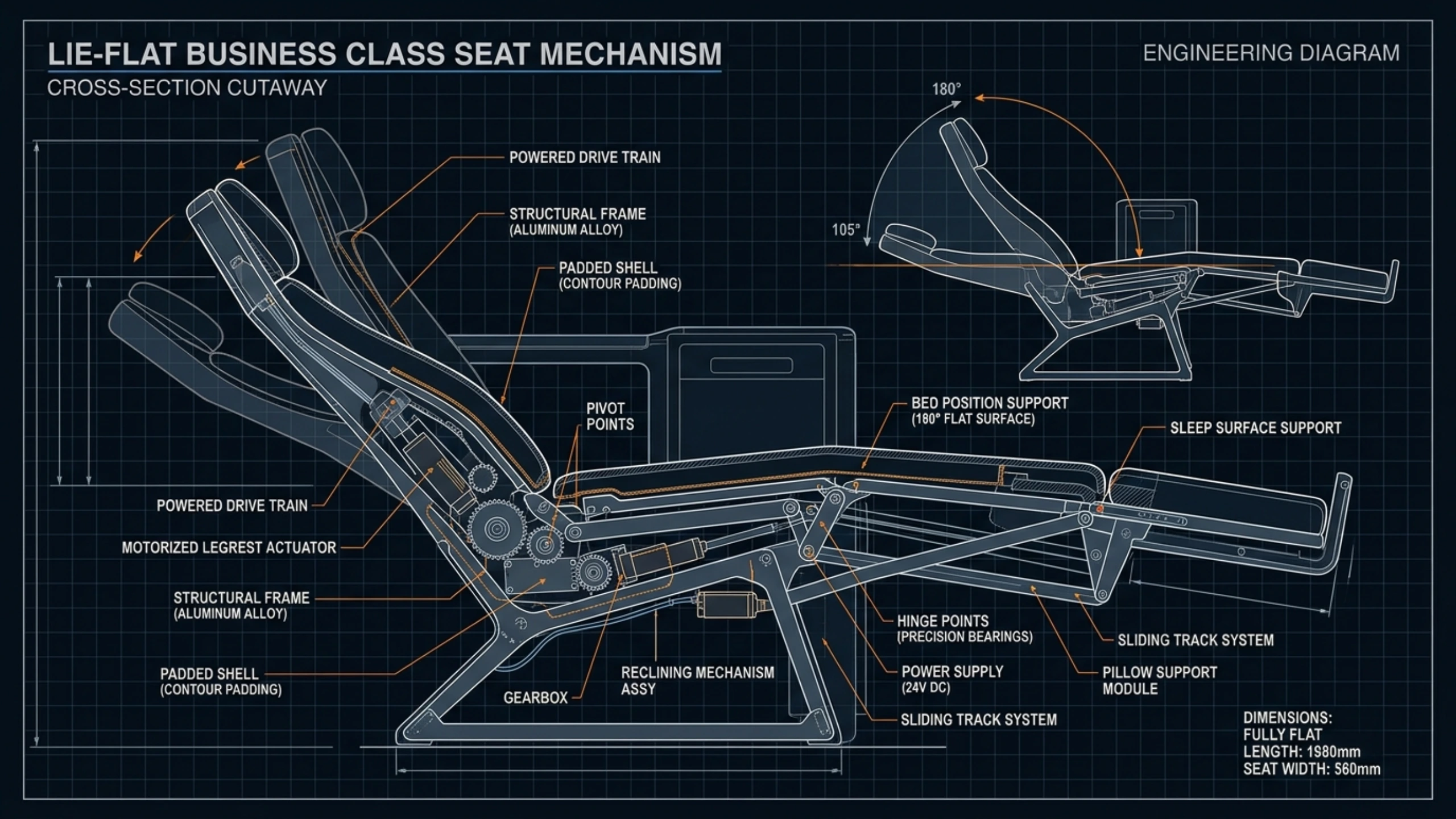
A true lie-flat seat reclines a full 180 degrees, so the seat bed forms a completely flat, horizontal surface — no incline, no slope toward your feet. That's it. That's the whole definition.
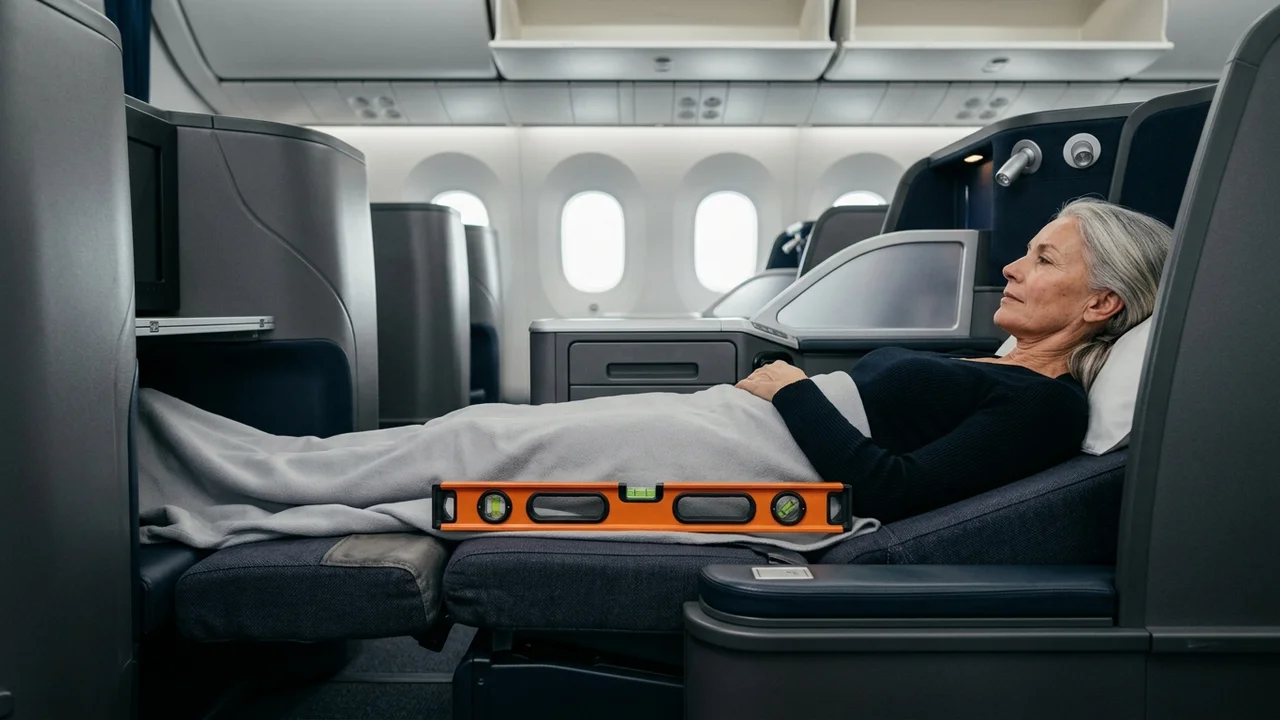
The problem is airlines started using "lie-flat" loosely in marketing back around 2010, and it stuck to seats that only get to 160 or 170 degrees. Those are technically called angled-flat seats, and they're a meaningfully worse product. More on that in a second.
82 inches
Longest lie-flat bed in business class (Delta One Suite, A350)
If you're trying to figure out whether business class is even worth the upgrade in the first place, I'd point you to our is business class worth it guide — the seat is genuinely the biggest variable in that math.
Is angled-flat the same as lie-flat?
No, and this trips people up constantly. An angled-flat seat reclines to somewhere between 160 and 170 degrees. It looks flat in photos. It is not flat.
Because the seat pan tilts, you end up sliding slightly toward the footwell all night, and most people wake up bracing themselves against the seat structure to keep from scooting down. On a 5-hour hop this is a non-issue. On anything over 6 hours — London to Singapore, New York to Johannesburg — it's the difference between landing rested and landing with a stiff neck.
Where you'll still find angled-flat seats in 2026
American's older A321T transcons, some Air Canada 777s pre-refresh, and a handful of Asian carriers on regional widebodies still fly angled-flat product. Always check the aircraft type before assuming "business class" means true lie-flat — see the SeatGuru note below.
The configurations, ranked by what actually matters
This is the part most guides skip, and it's the part that matters most. The configuration — how the seats are arranged and angled relative to the aisle — determines your privacy, your legroom, and whether you're climbing over a stranger to use the bathroom at 3am.
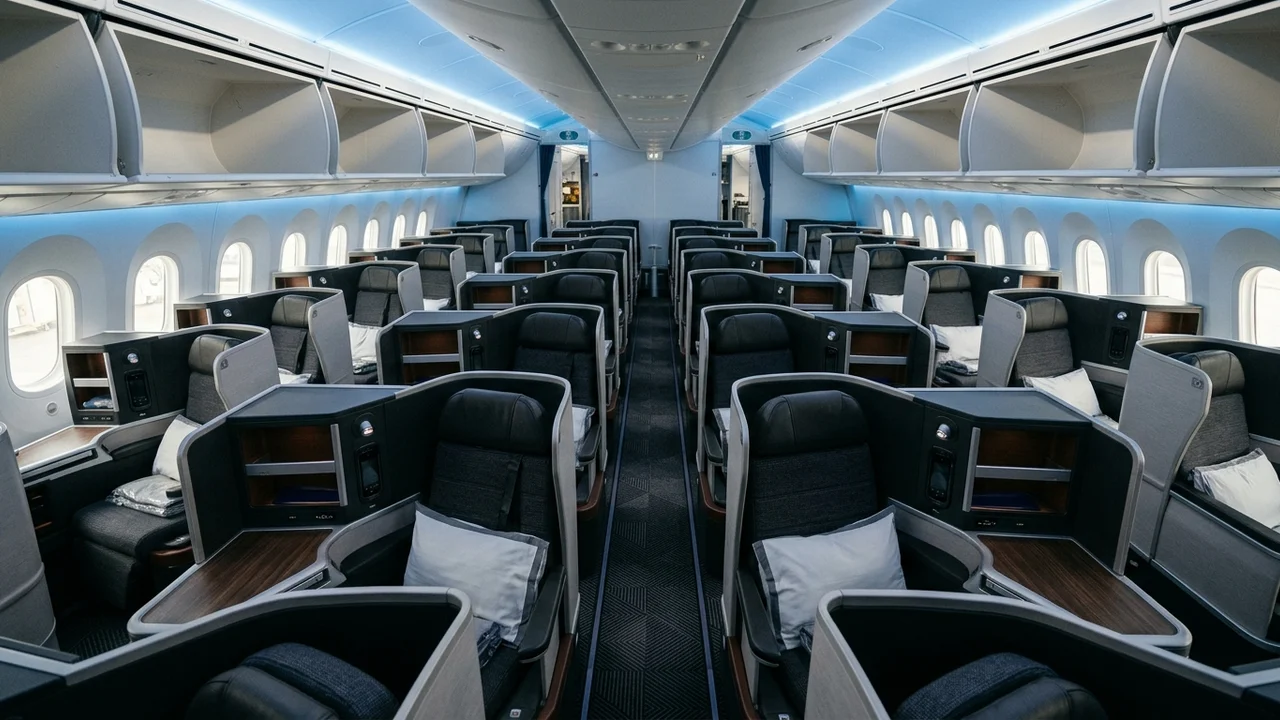
1-2-1 — the gold standard
In a 1-2-1 configuration, every single seat has direct aisle access. Nobody has to climb over you, and you never have to climb over anybody. Window seats hug the window, middle seats sit alone or in a paired pod down the center, and there's no such thing as a "bad" seat in the row.
This is what you want. If a fare search shows you a 1-2-1 cabin, book it and stop reading reviews.
Reverse herringbone is the most common version of 1-2-1 flying today. Window seats angle diagonally toward the window, feet tucked into a forward-facing footwell, which gives you a bit of privacy from the aisle without a door. You'll find it on:- Cathay Pacific's A350 (Aria Suite)
- American's 777-300ER and 787-9
- Delta's older A330s (pre-Suite retrofit)
- Air France's 777 and A350
I actually prefer reverse herringbone to some door suites for one reason: the diagonal angle means you're never staring straight into the aisle wall, which some fully-enclosed pods force on you. You can read our full reverse herringbone breakdown for the seat-by-seat details on each of those aircraft.
Staggered configuration is the other major flavor of 1-2-1. Seats alternate forward and backward down the cabin, sometimes shifting closer to or farther from the aisle row by row. The tricky part: not every seat in a staggered configuration actually gets aisle access — on some layouts, the seats tucked against the window in certain rows require a small step over a footwell extension. Delta's One Suite and British Airways' Club Suite both use staggered layouts, and they're excellent, but I'd still check the specific row on a seat map before assuming universal aisle access.Pro Tip
When a fare class is showing "business class" with no seat detail, ask BestBusinessClass.com to confirm the aircraft and cabin configuration before you pay. The same route can fly three different jets in a single week, and the seat product can be completely different each time.
2-2-2 — say no if you can
Old-school 2-2-2 configurations put two seats together in the middle of the cabin, which means somebody's climbing over somebody to get to the aisle unless you're traveling as a pair. You'll still find this on some United 767s and a few Lufthansa A340s that haven't been retrofitted yet.
It's not unbearable. But if you're flying solo and end up in a middle seat of a 2-2-2 pair, you've basically paid business class money for a seat you can't leave without waking your neighbor. I'd avoid it if there's any alternative on the route, and I'd specifically ask about it if you're booking business class to Tokyo or other long Pacific routes where some carriers still fly older birds.
Door suites vs. open suites — does the door matter?
This is the debate everyone wants settled, so here's my honest take after flying both extensively: the door matters a lot for privacy and almost nothing for sleep quality.
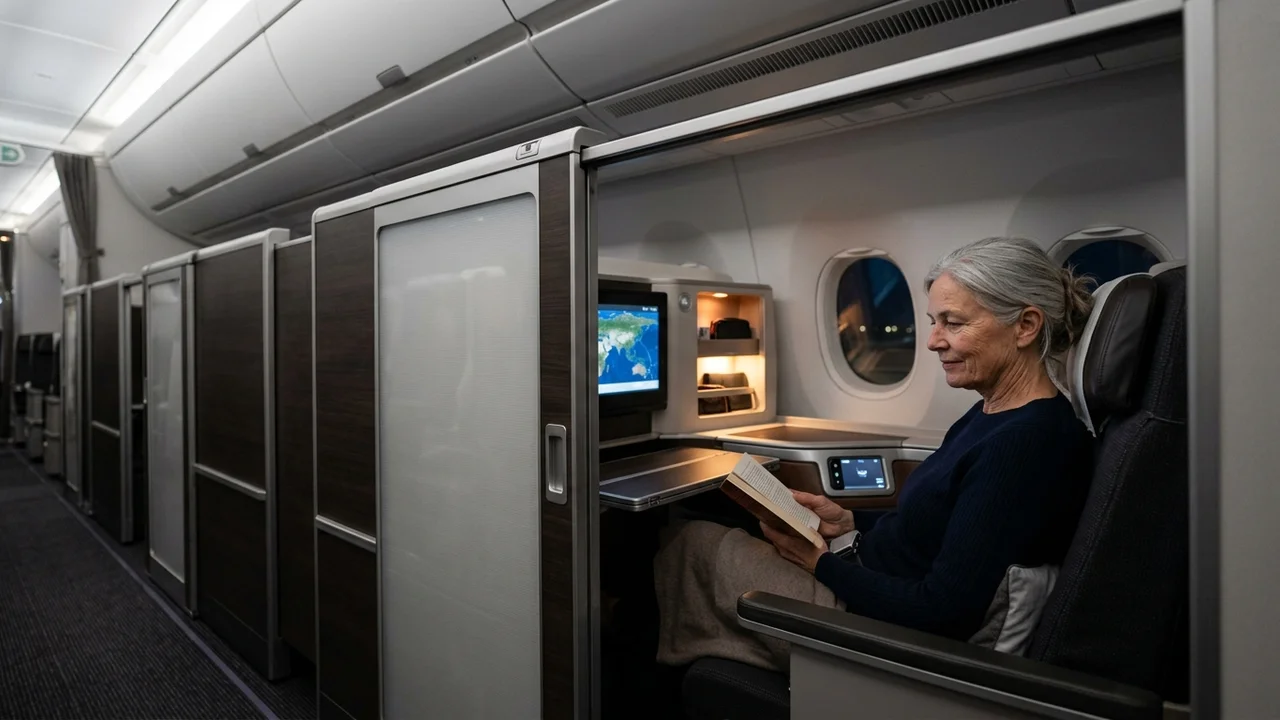
A door suite gives you a sliding or folding door that closes you into your own space. Qatar's Qsuite started this trend hard back in 2017, and now it's basically the flagship differentiator for premium carriers:
- Qatar Airways Qsuite — sliding privacy doors, and the middle seats can convert into a family or business suite for four people. I've used this on a Doha-to-JFK flight with a colleague and it genuinely felt like a small conference room at 40,000 feet.
- Delta One Suite — door plus the longest bed in the industry at 82 inches on the A350.
- British Airways Club Suite — door, though the cabin still feels tighter than Qatar's because BA kept a narrower footprint per seat.
- ANA The Room — the widest suite flying today, at 43 inches, with a door, on their 777-300ER.
Doha (DOH)New York (JFK)
Qatar Airways · Business Class
$3,400
roundtrip
For a full breakdown of what you get inside one of these, our Qatar Airways business class review covers the Qsuite in detail, including the food and the actual door mechanism (it's a manual slide, not automatic, and yes it locks).
Open suites — United Polaris, older Emirates 777 cabins, Singapore's older 777 business — give you a proper flat bed and usually a privacy divider or wing between seats, just no door that fully closes. Honestly? For actually sleeping, I don't notice much difference. The bed is the bed. What the door buys you is the psychological sense of a private room, which matters a lot if you're working on a laptop with sensitive documents, or if you just don't want a flight attendant making eye contact with you every time they walk past.
When the door actually matters
Overnight flights where you want zero interruption — red-eyes, long-hauls over 10 hours — the door earns its keep. On daytime flights under 6 hours, I'd take a great open suite over a mediocre door suite every time. Comfort of the actual seat cushion and recline geometry beats the door.
Bed length and width — the numbers nobody tells you upfront
This is where things get genuinely uneven across the industry, and it's the detail that decides whether you sleep or spend six hours with your knees against a wall.
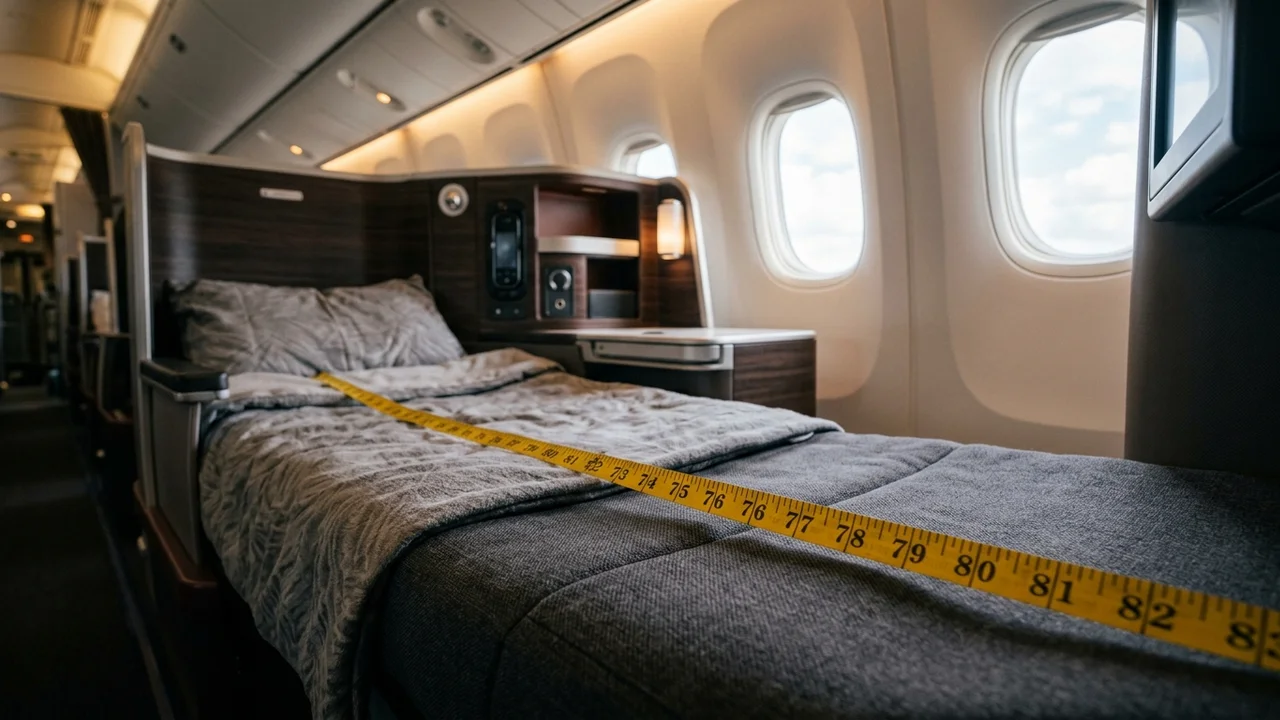
Bed length in business class ranges from about 73 inches on the tightest angled-flat products up to 82 inches on Delta's newest Suite. If you're over 6'2", anything under 78 inches is going to feel short — I'm 6'1" and I notice the difference between a 76-inch bed and an 80-inch bed immediately, especially at the ankles.
Width is the other number people ignore, and it swings even harder — from around 18 inches on tighter reverse herringbone pods up to 43 inches for ANA's The Room, which is basically a private cabin with a lie-flat seat business class bed inside it rather than a seat that becomes a bed.
43 inches
Widest business class suite (ANA The Room, 777-300ER)
Here's a quick comparison of what you're actually getting across the major cabin types flying today:
| Configuration | Aisle access | Bed length | Door | Example |
|---|---|---|---|---|
| Reverse herringbone | Every seat | 76-78" | No | Cathay A350 |
| Staggered | Most seats | 78-82" | Yes (newer) | Delta One Suite |
| Qsuite (1-2-1 convertible) | Every seat | 79" | Yes | Qatar Qsuite |
| 2-2-2 | Aisle seats only | 73-76" | No | United 767 (pre-refresh) |
What's the difference between a suite and a regular business class seat?
A "suite" usually just means the seat has some kind of enclosure — a door, a shell, high walls — that separates it from the aisle and neighboring seats. A regular business class seat without suite branding still lie-flat reclines, still gets you a real bed, it just doesn't have that enclosed feel. The seat mechanics underneath are often nearly identical; the difference is the shell built around it. Don't assume "suite" always means bigger — some suites are actually narrower than open seats because the walls eat into the width.
How to check before you book
Don't trust the word "lie-flat" on a fare listing by itself. Here's what I actually do before booking any long-haul business fare:
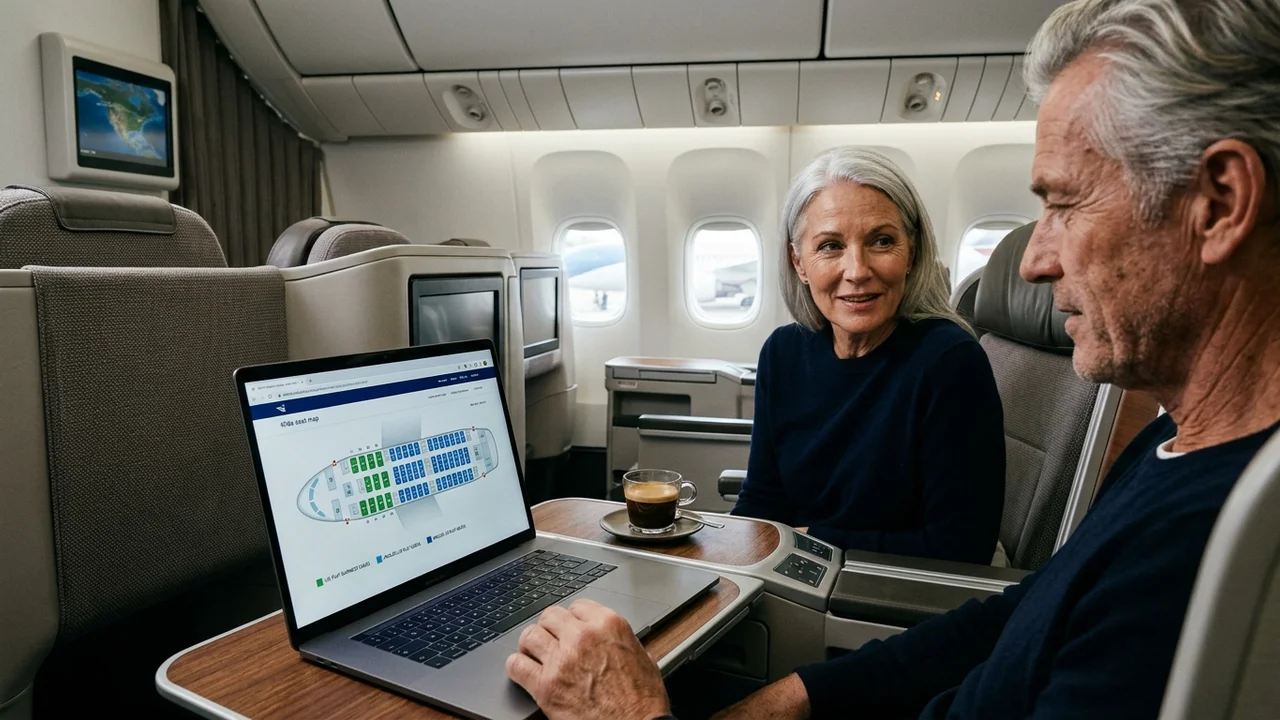
- Check SeatGuru for the specific flight number and aircraft — it'll flag angled-flat seats, bad legroom rows, and seats near galleys or bathrooms.
- Look up the aircraft type, not just the airline. The same airline can fly three different business class products on the same route depending on which plane shows up that day. A United flight JFK-LHR might be Polaris 767 or Polaris 777, and the seat width differs.
- Cross-reference the airline's own seat map on their booking site — it'll usually show you exact configuration (1-2-1 vs 2-2-2) for that specific tail.
- Ask a consolidator who knows the fleet. This is honestly the fastest method. BestBusinessClass.com deals with these seat maps daily and can tell you in under a minute whether a fare is putting you on a reverse herringbone A350 or an old angled-flat 767.
Pro Tip
Aircraft type matters more than airline loyalty. A "downgrade" from a legacy carrier's newest A350 to a budget carrier's newest A350 will usually beat an old-school configuration from a brand name airline. Chase the plane, not the logo.
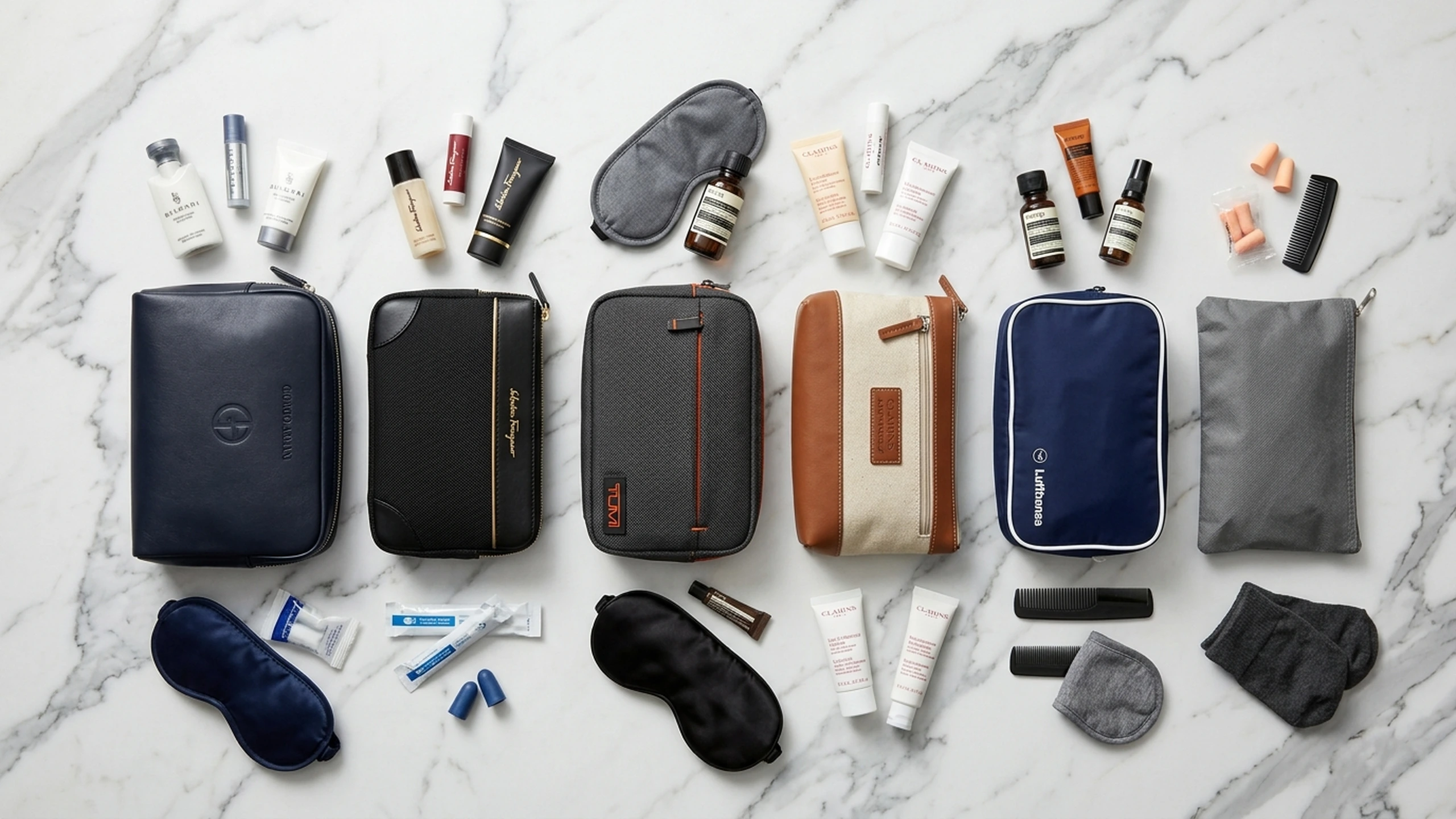
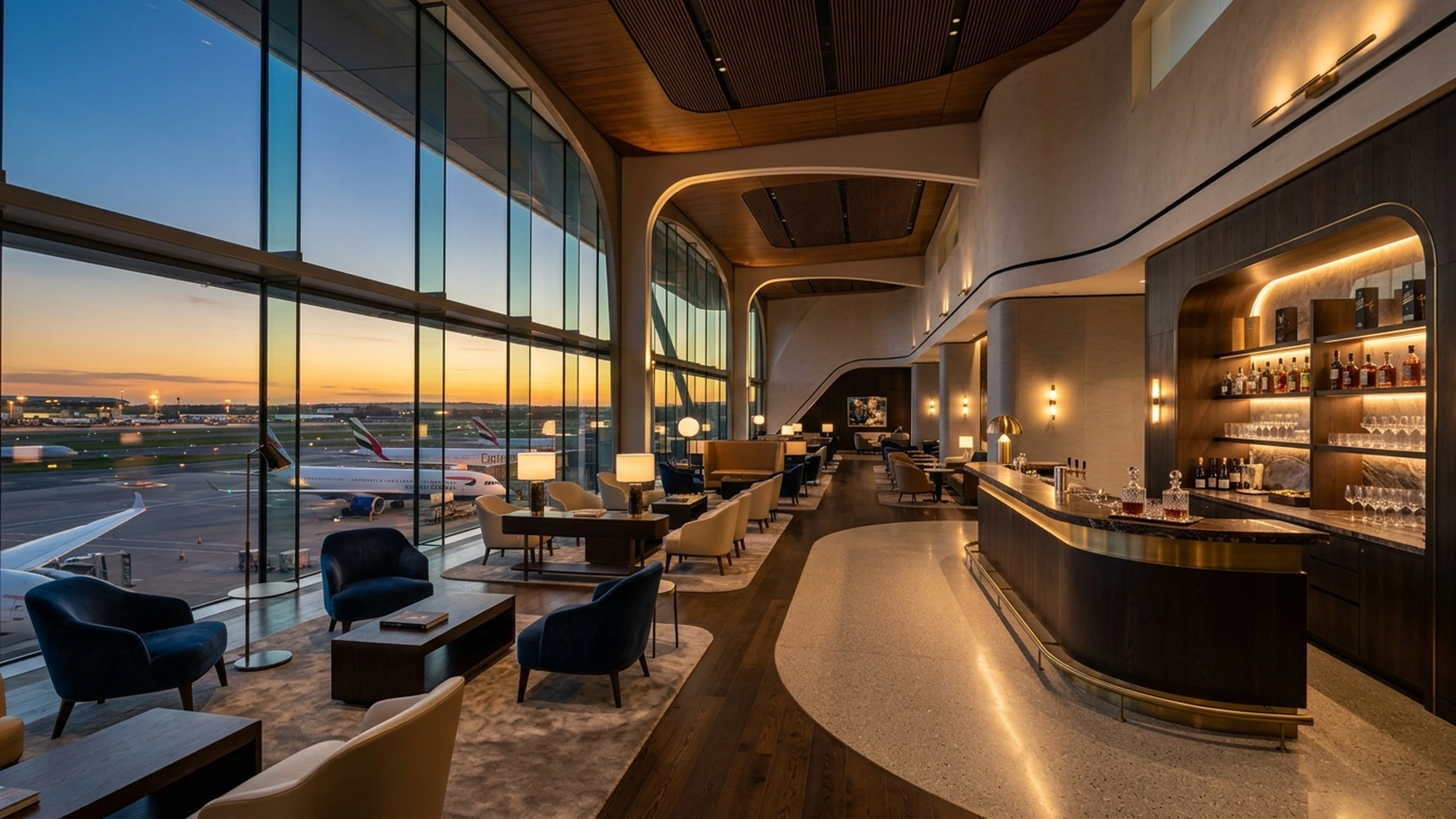
If you want to see what else typically comes bundled with these seats — lounge access, amenity kits, dining — our what's included guide walks through the rest of the experience beyond just the bed.
What I'd actually book in 2026
If I'm picking for myself on a long-haul, I'm choosing a 1-2-1 configuration every time, door suite if the price gap isn't outrageous, and I'm checking the aircraft type before I even look at the price. A Qsuite or Delta One Suite fare running $200-400 more than a tired 2-2-2 cabin is worth it on anything over 8 hours in the air.

For short-haul or redeye domestic hops under 5 hours, I'll take a solid angled-flat or open-suite 1-2-1 seat and not think twice — the marginal comfort gain from a door suite isn't worth chasing on a 4-hour flight.
You can browse current deals to see live pricing across these configurations, or check our New York to London route guide for a real-world look at how the seat product varies carrier to carrier on one of the most competitive business class routes in the world.
The short version: know your configuration before your price. A cheap 2-2-2 fare isn't actually cheaper if you land exhausted and can't work the next day.
Call (855) 815-4774 for discounted business class fares
Call NowThis article was created with AI assistance and reviewed by our editorial team.
#glossary#lie-flat#seat-types#cabin-product#buyer-guide
Enjoy our content? Make us a preferred source on Google.
Business class deals, delivered
Join savvy travelers who receive exclusive deals, route tips, and insider knowledge. Free, weekly, no spam.
Unsubscribe anytime. We respect your inbox.
By submitting, you agree to our Privacy Policy and Terms of Service.
Ready to book your business class flight?
Our specialists access unpublished fares and save you up to 40% on premium cabins.